

A Practical Guide to Leadership Development
How to Build a Leadership Development Program That Gets Results
I want to tell you about a moment in a simulator that changed how I think about building leaders.
It wasn’t dramatic. No emergency. No near-miss. I was running a check ride with a young pilot: good hands, solid instincts, the kind of natural you don’t have to worry about in the air. About twenty minutes in, he froze. Not on the controls. In his head. Too many inputs, no framework to process them through. He had the skills. He didn’t have the system.
Watching him thrash through that uncertainty, I recognized something I’d seen a hundred times since, in boardrooms, hospital operating rooms, and executive off-sites. Talented people, completely undone when the pressure arrived. Not because they lacked ability. Because nobody had ever given them a repeatable system for thinking and executing under fire.
That’s what leadership development is really about. Not finding natural-born leaders. Not running your best people through a two-day off-site and calling it a program. Done properly, leadership development is the process of giving your people a shared operating system: a common language for planning, executing, and learning that holds up when things get hard.
For organizations serious about execution, that’s not a training expense. It’s a core operational capability.
What Is Leadership Development and Why Does It Matter?
Leadership development is the strategic, ongoing process of building the skills, frameworks, and mindset your people need to lead effectively under pressure and execute your organization’s strategy with consistency.
Notice what that definition doesn’t say. It doesn’t say “run workshops.” It doesn’t say “invest in an off-site.” It doesn’t say “hire a motivational speaker,” and I say that as someone who delivers keynotes for a living.
Real leadership development is the difference between hoping your people rise to the occasion and building a system that guarantees they will. Teams don’t rise to the occasion under pressure. They fall to the level of their training. That’s not pessimism. That’s physics. I learned it at nineteen years old in Officer Training and I’ve watched it play out in Fortune 500 boardrooms for the last twenty years.
The gap between companies that get this right and those that don’t shows up on the bottom line faster than most executives expect.
Why Leadership Development Is Non-Negotiable
Here’s a number that should make you uncomfortable.
According to Gallup’s 2025 State of the Global Workplace report, 70 percent of the variance in team engagement is attributable to the manager. Not the strategy. Not the market. The manager. Global employee engagement fell to 21 percent in 2024, down from 23 percent the year before: a drop equivalent to what the world saw during the COVID lockdowns of 2020. The cost of that disengagement was $438 billion in lost productivity. [2]
You’re not looking at a morale problem. You’re looking at a structural leadership gap, priced in nine figures.
Organizations globally invest an estimated $60 billion a year in leadership development to try to close it, according to a 2024 peer-reviewed study published in Behavioral Sciences. [5] The same study found that workplace application of learning is typically low and many programs underperform or fail outright. The spending isn’t the problem. It’s what the spending is pointed at. Most corporate leadership development addresses behavior, teaching people what to do differently without addressing why they can’t. It’s like giving someone a new pair of running shoes when they have a broken leg.
The fact is, an investment in leadership is the single biggest lever in your organization to drive consistent, evolutionary growth. You don’t need to find natural leaders. You need to accelerate the growth of the leaders you already have.
Drive Engagement and Keep Your Best People
Your best people don’t leave companies. They leave managers. Poor leadership and a lack of growth opportunities are consistently among the top reasons top talent walks out the door. When you develop your leaders systematically, you change that equation.
Effective leaders create environments where people know their role, understand the mission, and feel connected to something bigger than the task in front of them. As Grant Thornton notes in their work on mentorship, guidance, support, and experience from mentors help people overcome obstacles and build their leadership skills. [1] That’s not a soft observation. That’s a retention strategy.
Build Agility and a Lasting Competitive Edge
A single great product gives you a temporary advantage. A deep bench of capable leaders gives you a durable one. When you build a culture of continuous improvement, you create internal capability your competitors cannot simply buy or replicate. Leaders at every level equipped to solve problems and drive performance: that compounds over time in a way that talent acquisition never will.
The Building Blocks of an Effective Leadership Development Program
Here’s the thing. Most leadership programs are built backwards. They start with content: a curriculum, a speaker lineup, a portal full of e-learning modules. Then they wonder why nothing has changed six months later.
An effective program starts with a destination.
In our world, we call it a High-Definition Destination, or HDD. We don’t set vague goals. We define a crystal-clear picture of what success looks like, specific enough that there’s no argument about whether you’ve arrived. Not “develop better leaders,” but “build a pipeline where every manager can run a nameless, rankless debrief after every mission and our engagement scores move ten points in twelve months.” That’s a destination. You can navigate to it.
From that HDD, you build the system.
Clear Learning Paths, Not Random Workshops
Random workshops create temporary buzz. That’s it. An effective program provides a logical progression tied directly to your most important business objectives and scaled to leaders at different stages of their careers. A first-year frontline manager needs different tools than a senior executive running a P&L. The core principles, clarity, accountability, and execution rhythm, are the same. The depth and application are different.
Meaningful Mentorship and Coaching
No leader develops in a vacuum. The most effective programs embed mentorship and coaching as structural requirements, not optional extras. As HowNow notes in their research, mentorship plays a crucial role in leadership development, providing guidance, support, and valuable insights to aspiring leaders. [3] Coaching is more targeted, helping a leader navigate a specific obstacle in real time. The combination is what makes learning stick.
Consistent Feedback and Honest Assessment
Leaders can’t grow without honest feedback, delivered consistently. The best programs create a safe environment where people can apply new skills, fall short, and learn without fear of judgment.
In the fighter pilot community, we built that into the architecture of every mission. Every flight ends with a debrief. Rank goes out the door. What happened, why it happened, and what we do differently next time: that’s the only conversation that matters. That same discipline, applied systematically inside an organization, turns feedback from a once-a-year event into a daily growth engine.
Learning by Doing
You cannot learn to fly from a slide deck. Leadership is a practice. The most impactful programs push participants into action: real projects, difficult conversations, high-stakes scenarios where lessons are applied under pressure. That’s where a framework moves from a concept on a whiteboard to an automatic response under fire.
The Skills That Actually Matter
A program is only as good as the capabilities it builds. After twenty years of applying fighter pilot methodology across industries, including hospitality, logistics, healthcare, and professional sports, I’ve found four skills that consistently drive results.
Communication and Influence
Great leaders move people to action. Not through authority, through clarity. The ability to frame a mission, ensure everyone understands their role, and build influence that earns commitment rather than compliance is foundational. Most leaders significantly underestimate how much their communication style is limiting their team’s performance. The gap between what a leader thinks they said and what was actually understood is where execution breaks down.
Strategic Thinking and Decision-Making
Your leaders need to see the bigger picture. To understand how their team’s work connects to the organization’s HDD. To make sound decisions quickly, with incomplete information and real consequences. That’s a trained capability, not a natural talent. It starts with a repeatable planning framework: the kind that forces people to think through threats, resources, contingencies, and roles before they brief the mission, not during execution.
Emotional Intelligence and Self-Awareness
In the cockpit, self-awareness is a survival skill. If you don’t know your own tendencies, your own biases, your own triggers, you become a liability to yourself and to the jet. In business, it’s the same.
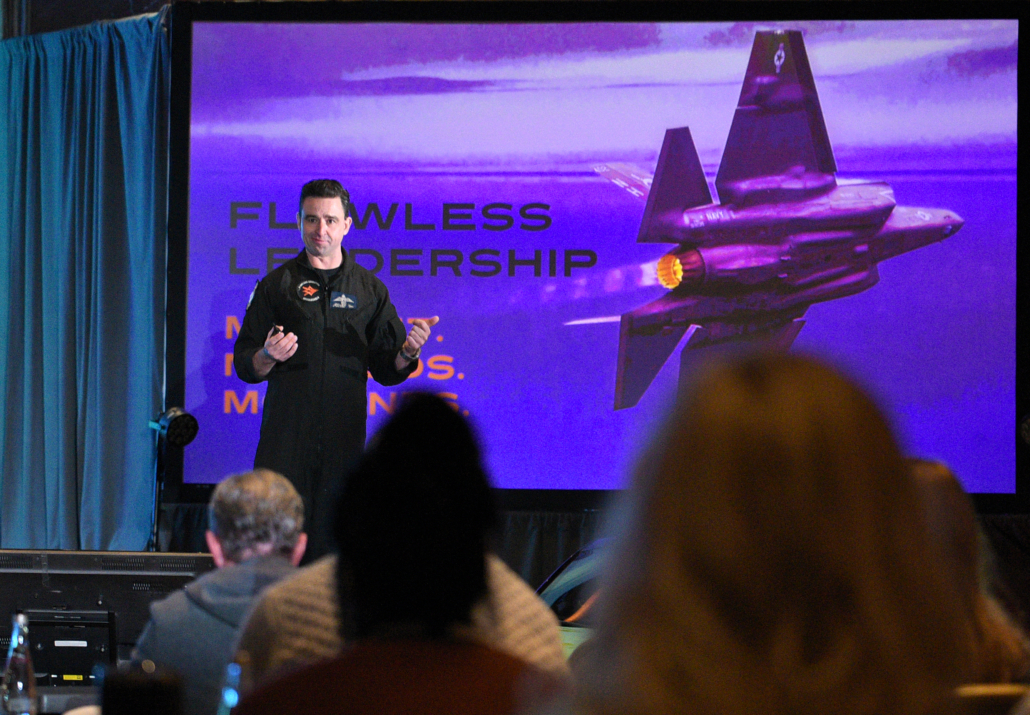
This is the core of what we call the Three B’s: Biases, Beliefs, and Behaviors. The Three B’s framework sits at the foundation of the Flawless Leadership℠ system. Change the Biases and the Beliefs, and the Behaviors follow. Try to change only the Behaviors and you’re fighting the current every single day.
Adaptability and Leading Through Change
The business environment doesn’t stay still. Your leaders need to guide their teams through uncertainty without losing momentum or clarity. The Fighter Pilot Mindset℠ isn’t about being fearless. It’s about having a system so well-rehearsed that when things go sideways, your leaders don’t freeze. They execute.
How to Design a Framework That Actually Works
A framework that works is not a binder. It’s not a portal. It’s a living system built around four elements.
Start With an Honest Assessment
You cannot build a path forward without knowing where you stand today. Before designing a single module, get an honest diagnosis of your team’s current leadership capabilities. Use 360-degree feedback, behavioral assessments, and structured conversations. What are the common gaps holding your teams back? Where are your high-potentials stalling?
Here’s a useful baseline: nearly 60 percent of first-time managers say they received no training when they transitioned into their leadership roles. [10] If that’s true at your organization, the diagnosis doesn’t need to be complicated.
Map Out Clear Growth Paths
Once you know where you are, you can define where you’re going. Embed mentorship from the beginning. Pair emerging leaders with experienced ones. Structure learning sequentially so each stage builds on the last and every participant can see the destination they’re navigating toward.
Align Development to Business Goals
This is where most programs fail. Leadership development that operates independently of your business strategy is theater. It looks like progress. It isn’t. Every element of your framework should answer one question: what is the biggest challenge our business is facing right now, and how does this program equip our leaders to solve it?
Harvard Business Review has noted that leadership programs work best when directly linked to a core business goal. [6] That’s not a new insight. Most organizations still haven’t acted on it.
Define How You’ll Measure Success
If you can’t measure it, it doesn’t count. Define your success metrics before you start. Not attendance figures. Not satisfaction surveys. Real outcomes: team engagement shifts, project completion rates, retention of high-potentials, and revenue per leader. Track them before, during, and after. When you can draw a direct line from leadership capability to business performance, you’ve built something worth defending when budgets tighten.
The Psychology of Programs That Stick
You can have the best content in the world and still produce nothing. The difference between programs that create lasting change and programs that produce a temporary buzz is psychology. Four principles determine whether learning sticks.
Self-Awareness as the Starting Point
You can’t fix a problem you don’t know you have. Real development starts with honest self-assessment and then the discipline to sit with what the feedback actually says. What patterns keep showing up? What will I do differently? That loop from feedback to insight to action is where growth lives.
Shifting Mindsets, Not Just Behaviors
Layering new behaviors on top of old thinking is a recipe for reverting under pressure. Lasting change happens from the inside out. In the Flawless Leadership℠ system, we work on the Three B’s: Biases, Beliefs, and Behaviors, in that order. You can’t shortcut the sequence.
Peer Learning and Connection
Leadership can be isolating. Learning doesn’t have to be. When development happens in a group, leaders see problems from different perspectives, build honest relationships, and hold each other accountable in ways a solo training experience never can. Harvard Business Review has noted that peer connections improve both individual performance and broader organizational culture. [8] That matters as much as the curriculum.
Practice in the Real World
A workshop is a starting point, not a finish line. Every project, every difficult conversation, every high-stakes meeting is a development rep. An effective program builds deliberate connections between training content and the leader’s daily work.
That’s the core of FLEX, FLawless EXecution, the methodology at the heart of everything we do at Afterburner. FLEX runs on a four-phase closed loop: Plan, Brief, Execute, Debrief. We call those phases PBED. The debrief feeds into the next plan. Each cycle is sharper than the last. That compounding effect, 1 percent better per mission, is where real growth accumulates. Not in the workshop. In the work itself.
Common Roadblocks and How to Spot Them
Even well-built programs hit turbulence. Here are four failure points to watch for.
Senior Leaders Who Aren’t On Board
A leadership program without executive support is a car without an engine. As Korn Ferry has noted, senior leaders need to visibly and actively support leadership development for it to take hold. [9] True support isn’t signing a budget. It’s participation. Watch the early signals: executives who skip the kick-off, managers who pull people from sessions for “urgent” priorities, quarterly budget scrutiny with no defense prepared.
Training Disconnected from Reality
If your leaders walk out of a session thinking “that would never work here,” the program has a relevance problem. Training grounded in real challenges, facilitated by people who have done the actual work, closes that gap. A mentor who offers contextually relevant, real-world perspective is worth ten times an abstract model nobody can apply on Monday morning.
Resistance and Apathy
Apathy isn’t laziness. It’s a sign the program hasn’t answered the most important question any participant asks: what’s in it for me? If the training feels like a distraction from real work rather than a tool that makes real work easier, people will disengage. The program has to solve problems the participants actually have.
No Clear Measurement System
Without measurement, your program will always be vulnerable when budgets compress. The initiatives that survive are the ones with a clear return on investment. A 2023 study of 752 leadership development managers found the average return is $7 for every $1 invested in structured programs. [7] That case is worth making explicitly before the finance team starts asking questions.
Building a Culture of Continuous Leadership Growth
A leadership development program is not a one-time event. It’s the start of a cultural shift.
Weave Development Into Daily Work
The most effective learning doesn’t happen in a conference room. It happens in the flow of work. Every meeting, every difficult conversation, every project outcome is a development rep. When leaders frame daily challenges as growth opportunities, development stops being an annual event and starts being the way the team operates.
Create Systems for Accountability and Learning
For development to stick, you need structure. A consistent debrief after every significant mission, whether that’s a project, a product launch, or a difficult quarter, is the most powerful accountability tool I know. It doesn’t require a consultant. It requires thirty minutes, a nameless and rankless room, and four honest questions.
That’s ORCA: Objective, Result, Cause, Action. ORCA is the debrief framework inside the FLEX system. Objective: did we achieve what we set out to achieve? Result: what actually happened, facts not feelings? Cause: trace the root cause to a person and a decision, not a category. Action: one clear thing that changes next time. The ORCA action feeds directly into the next plan. That’s the loop closing. You can read more about how the ORCA debrief method works in practice.
Ensure Leaders Model the Way
Culture is built from the top down. If you want a culture of growth and accountability, your senior leaders have to be its most visible practitioners. When an executive shares their own development goals openly, admits when they were wrong, and is heard applying new frameworks in the next leadership meeting, that signal travels through the entire organization faster than any program rollout.
Stay Adaptable to Business Needs
The skills critical today may not be the ones you need in two years. Regularly assess your framework against your current strategic priorities. Tying learning directly to business outcomes, the way we do in the 90-Day Accelerator, is what keeps the program earning its place as a driver of real results rather than a line item to cut.
If you want to understand what a systematic approach to leadership looks like end to end, the Flawless Leadership℠ program is a good place to start. You can also learn more about our approach to execution methodology at Afterburner.
Measuring the True Impact of Your Program
Investing in leadership development without a measurement system is flying blind. You feel like you’re moving. You have no data to confirm direction or altitude.
Engagement and Retention Numbers
If your program is working, you should see a positive shift in engagement and retention metrics, particularly on teams led by managers who have gone through the training. A meaningful drop in turnover or a rise in engagement scores on specific teams can often be traced directly back to a manager applying new skills. That’s your leading indicator and the one that will get the CFO’s attention.
Tangible Business Results
The most compelling measurement is a direct tie to business outcomes. Are projects completing on time and on budget more consistently? Are sales metrics or customer satisfaction scores improving in certain departments? Track the KPIs that matter before, during, and after the program. As Harvard Business Review has observed, employees engage more deeply with learning when it helps them reach their personal goals alongside the company’s goals. [11] When those align, development directly fuels performance.
Direct Feedback from Participants
Quantitative data tells you the “what.” Qualitative feedback tells you the “why.” According to the Center for Creative Leadership, follow-up conversations after 360-degree feedback are among the strongest predictors of a leader becoming more effective. [12] That conversation, guided by a coach or mentor, is where insight becomes action.
Observable Long-Term Behavior Change
Real development shows up in sustained behavioral change. Are your leaders communicating with more clarity? Delegating more effectively? Handling pressure without spiraling? These shifts can be built into manager check-ins or integrated into your performance review cycle. When leaders improve, the effect ripples through every person they lead. That’s the ultimate return on investment.
Related Articles
- The ORCA Debrief Method: The Key to High-Performing Teams — Afterburner
- Flawless Leadership℠ Development Program — Afterburner
FAQ
What is leadership development and why does it matter for business performance?
Leadership development is the structured, ongoing process of building the skills, frameworks, and mindset your people need to lead effectively under pressure and execute your organization’s strategy with consistency. It matters because execution gaps, missed targets, misaligned teams, and talented people leaving, almost always trace back to a gap in leadership. When you develop your leaders systematically, you’re not just improving individual managers. You’re installing a shared operating system across your entire organization.
How is a leadership development framework different from a one-off training workshop?
A framework is a living system built around a continuous cycle of planning, application, feedback, and refinement. A one-off workshop creates a temporary boost of inspiration. A framework creates a repeatable operating rhythm like FLEX (FLawless EXecution), where every mission ends with a debrief, every debrief feeds the next plan, and the team gets 1 percent better every cycle. Compounded daily, that 1 percent doesn’t make you 365 percent better by year’s end. It makes you thirty-seven times better.
How do we measure the ROI of a leadership development program?
Define your success metrics before you start. Track changes in employee engagement and retention rates, project completion times, and the KPIs most critical to your business, before, during, and after the program. Research involving 752 leadership development managers found that organizations receive an average of $7 back for every $1 invested in structured programs. [7] Satisfaction surveys are not ROI.
What leadership skills should an effective program prioritize?
The four capabilities that consistently drive results are: clear communication and influence, strategic thinking and decision-making, emotional intelligence and self-awareness, and adaptability under pressure. These aren’t soft skills. They are the fundamental drivers of team performance and execution quality. A program built around these four, with real-world practice and honest feedback built in, creates the foundation for what we call the Fighter Pilot Mindset℠.
How do we get senior leaders to support a leadership development program?
Frame the initiative in terms of strategic business outcomes, not training deliverables. Show the cost of the current leadership gap in concrete terms: turnover, execution failures, and time spent managing up. Then get visible, active participation from the top. When senior leaders attend sessions, apply the frameworks publicly, and hold their teams accountable for showing up, the signal to the rest of the organization is clear. Buy-in from the top isn’t just helpful. It’s the program.
References
[1] Grant Thornton. (2022). Mentoring: A win-win for leadership development. https://www.grantthornton.com/insights/articles/human-capital/2022/mentoring-a-win-win-for-leadership-development
[2] Gallup. (2025). State of the Global Workplace 2025 Report. https://www.gallup.com/workplace/349484/state-of-the-global-workplace.aspx
[3] HowNow. (n.d.). The Role of Mentorship in Leadership Development. https://gethownow.com/blog/the-role-of-mentorship-in-leadership-development/
[4] Afterburner. (n.d.). Our Approach. https://www.afterburner.com/about/our-approach/
[5] Geerts, J. M. (2024). Maximizing the Impact and ROI of Leadership Development: A Theory- and Evidence-Informed Framework. Behavioral Sciences, 14(10), 955. https://doi.org/10.3390/bs14100955
[6] Harvard Business Impact. (2021). The Impact of Leadership Development. https://hbr.org/sponsored/2021/09/the-impact-of-leadership-development
[7] BetterManager / New Level Work. (2023). $7 for $1: A Breakthrough in Corporate Leadership ROI. https://www.newlevelwork.com/post/7-for-1-a-breakthrough-in-corporate-leadership-roi-2023-research
[8] Harvard Business Review. (2019). The Power of Peer Learning. https://hbr.org/2019/11/the-power-of-peer-learning
[9] Korn Ferry. (n.d.). Leadership Development That Works. https://www.kornferry.com/insights/this-week-in-leadership/leadership-development-that-works
[10] High5Test. (2024-2025). 25+ Leadership Training and Development Statistics. https://high5test.com/leadership-training-statistics/
[11] Harvard Business Review. (2018). Making Learning a Part of Everyday Work. https://hbr.org/2018/07/making-learning-a-part-of-everyday-work
[12] Center for Creative Leadership. (n.d.). The Power of 360-Degree Feedback. https://www.ccl.org/articles/leading-effectively-articles/the-power-of-360-degree-feedback/
[13] Afterburner. (n.d.). The ORCA Debrief Method. https://www.afterburner.com/the-orca-debrief-method-the-key-to-high-performing-teams/
[14] Afterburner. (n.d.). Flawless Leadership℠. https://www.afterburner.com/flawless-leadership/
[15] Afterburner. (n.d.). 90-Day Accelerator. https://www.afterburner.com/programs/90-day-accelerator/

