

Indoor Team Building Activities That Actually Build Teams
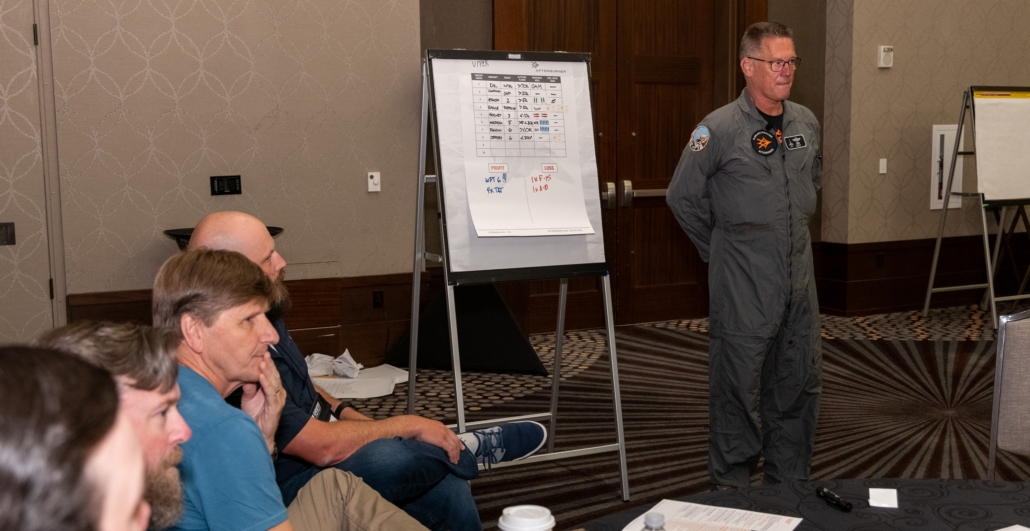
Indoor Team Building Activities That Actually Work
By Christian “Boo” Boucousis, CEO of Afterburner
I was 22 years old, strapped into the cockpit of a jet trainer on the western coast of Australia, staring at weather that looked like it wanted to swallow us whole. My instructor Muff was in the back seat. My coursemate Beno and his instructor were in the jet beside us, engines running, fuel burning. Every second on the ground was a second closer to a wasted mission. And I froze.
Not because I didn’t know the procedures. I knew them cold. I froze because I’d never been in that exact moment before, where the theory meets the ambiguity of real life and you have to make a call. I keyed the mic and said, “The weather looks pretty bad outside the window.” Silence. I was deferring the decision. I didn’t have the practiced judgment yet.
That moment taught me something I’ve carried through 20 years of leading businesses: you can’t wait for the storm to find out if your team can handle it. You have to build that judgment before the pressure arrives. And that’s the real purpose of indoor team building activities, not trust falls, not awkward icebreakers, but deliberate practice that prepares your team to communicate, decide, and execute when it actually matters.
Indoor team building activities are structured exercises conducted in a controlled environment designed to strengthen how a team communicates, collaborates, and solves problems together. When aligned with a clear business objective and followed by a structured debrief, these activities function as a training ground for high-stakes execution, building the muscle memory your team needs to perform under pressure.
Key Takeaways
- Start with the mission, not the menu. Identify the specific execution gap you’re trying to close, whether that’s poor communication, misalignment, or slow decision-making, then choose an activity that targets it directly.
- Match the activity to the team’s scale. Small teams need trust. Mid-sized teams need process. Large groups need cross-functional alignment. One size fits nobody.
- The debrief is the real event. Any activity without a structured debrief is entertainment, not development. Use the ORCA framework (Objective, Result, Cause, Action) to extract lessons that compound into lasting performance gains.
What Is Indoor Team Building, Really?
Let me tell you what it’s not. It’s not a pizza party with a side of forced fun. It’s not a rainy-day plan B because somebody forgot to book the ropes course.
Here’s the thing: indoor team building, done right, is a controlled rehearsal for the way your team operates under pressure. It removes the variables (weather, logistics, physical ability) so you can focus entirely on the internal mechanics. How does the team communicate when the plan falls apart? Who steps up? Who checks out? Where does information get lost between departments?
In the fighter pilot world, we don’t just train in the air. We spend hours in briefing rooms, simulators, and debriefs, all indoors, rehearsing the cognitive and communication skills that keep us alive at 1,200 miles per hour. The indoor environment isn’t a limitation. It’s an advantage. It strips away the noise so you can hear what’s really going on inside your team.
The activities can range from a five-minute exercise that kicks off a meeting to a full-day team building experience that simulates the pressure of a complex business challenge. What matters isn’t the format. It’s whether the activity was chosen with a specific purpose, and whether you close the loop with a debrief that feeds the lessons forward.
Why Indoor Team Building Matters for Execution
I’ve worked with thousands of leaders across industries, from hospitality and healthcare to logistics and publishing, and I can tell you the number one reason teams underperform isn’t a lack of talent. It’s a lack of practiced collaboration.
Most organizations expect flawless teamwork but never provide a space to rehearse it. They hire smart people, drop them into complex cross-functional projects, and hope the communication works itself out. That’s like handing someone a flight manual and telling them to land a jet.
FLEX, which stands for FLawless EXecution, is the methodology we teach at Afterburner. It’s built on the same Plan-Brief-Execute-Debrief (PBED) cycle fighter pilots have used for over 60 years. The debrief alone, which I’ll get into shortly, has transformed how organizations like Microsoft, the New York Giants, and Medtronic approach performance improvement. But here’s what people miss: the debrief only works if the team has the trust and communication habits to be honest with each other. And those habits are built through shared experiences, exactly what well-designed indoor team building provides.
Research backs this up. A 2017 meta-analysis published in PLOS ONE reviewed 51 studies covering 72 unique teamwork interventions and over 8,400 participants. The researchers found significant, medium-to-large positive effects on both teamwork behaviors and team performance, with the strongest gains showing up in healthcare, aviation, military, and academic settings. Interventions that used interactive and hands-on methods outperformed passive approaches like lectures.
When your team practices communication, decision-making, and problem-solving in a low-stakes environment, they build what fighter pilots call “muscle memory”: the automatic responses that keep performance high when pressure spikes. And they build the psychological safety that makes a real debrief possible.
How to Choose the Right Activity: Start with the Mission
Most leaders choose team building activities the way they choose a restaurant, whatever looks good on the menu. That’s backwards.
In the fighter pilot world, every mission starts with a clear objective. We call it an HDD, a High-Definition Destination, which is a crystal-clear, measurable picture of what success looks like. The same discipline applies here. Before you book anything, answer one question: what specific execution gap are you trying to close?
Is your team struggling with cross-departmental communication? Are decisions getting bottlenecked because people don’t trust each other enough to speak up? Is there a new team that hasn’t built the shared understanding needed to execute together?
The gap dictates the activity. Not the other way around.
Assess the Gap Before You Pick the Game
Talk to your people. Not in a town hall, but in one-on-one conversations or through a quick anonymous survey. Ask them where communication breaks down. Ask them what frustrates them about how the team operates. The answers will point you toward the right type of activity.
At Afterburner, we use the Six-Step Mission Planning process before any engagement. Step one is always the objective. Step two is always the threats, the obstacles that could prevent success. If you apply that same thinking to team building, you’ll stop picking activities based on what sounds fun and start picking activities based on what solves the problem.
Make Sure Everyone Can Participate
A team-building activity fails the moment someone feels excluded. Consider physical accessibility, introvert-extrovert dynamics, and cultural differences. The goal is to bring the whole team together, not spotlight the loudest voices while the quietest ones check out. Choose activities that offer multiple roles, some that require verbal leadership, others that reward observation, analysis, or coordination.
Align the Activity with Your Culture
If your organization values speed and decisiveness, choose an activity that rewards those traits. If you’re trying to build a culture of psychological safety, what fighter pilots call a “nameless, rankless” environment where rank stays at the door and everyone has an equal voice, choose an activity where hierarchy is deliberately removed. The best team building experiences feel like a natural extension of the culture you’re building, not a detour from it.
Activities by Team Size: Match the Method to the Mission
The dynamics of a five-person team are fundamentally different from a fifty-person department. What works for one can actively harm the other. Here’s how I think about it.
Small Teams (2-8 People): Build Trust First
In a small team, every relationship is load-bearing. If two people on a team of five don’t trust each other, 40% of your communication network is compromised.
Focus on activities that deepen personal connection and reveal different working styles. Personality assessments followed by a candid group discussion work well here. So do problem-solving challenges that require each person’s unique input. The goal is psychological safety, creating the conditions where people feel comfortable admitting mistakes, asking for help, and challenging each other’s assumptions. That’s the foundation a small team needs to debrief honestly, which is where real improvement begins.
Mid-Sized Teams (9-20 People): Improve Process and Collaboration
Once a team grows past eight or nine people, communication lines multiply. Sub-groups form. Information gets siloed. Alignment becomes a real problem.
At this scale, the focus shifts from personal trust to operational collaboration. Escape rooms, strategic simulations, and project-based challenges are effective because they force the group to clarify roles, communicate under pressure, and develop a shared plan, the same skills they need on real projects. Customized team building workshops that mirror actual business challenges will resonate far more than a generic game because the team can see the direct connection to their daily work.
Large Groups (20+ People): Break Down Silos
In large organizations, the biggest threat to execution isn’t individual performance. It’s fragmentation. Marketing doesn’t know what engineering is building. Sales is making promises operations can’t keep. Everyone is busy, but nobody is aligned.
I saw this firsthand working with Medtronic’s national sales division. Nine VPs, nine regional teams, each operating in their own silo. The sales president shifted from nine individual calls to one shared debrief. Within weeks, teams were sharing tactics across regions. The Washington VP shared a new approach to medical center conversations. The Florida VP adapted it and solved a problem with a doctor who’d been resistant to their product. Within four months, the division had sold out of inventory. Those VPs couldn’t get enough of the shared calls. They called their process “Flawless Product Execution.”
For large-group indoor activities, structure is essential. Mix people from different departments into smaller teams working on a common objective. Bring in experienced facilitators who can manage the dynamics and keep the event productive. The goal is a shared experience that creates cross-functional alignment, a sense that “we’re all on the same mission.”
Low-Prep Activities You Can Start Today
You don’t need a full-day offsite to start building team cohesion. Consistent, small-scale exercises sharpen the communication habits that matter. Think of them as daily flight checks for your team.
Quick Icebreakers (Under 5 Minutes)
Don’t dismiss these. In the debrief room, fighter pilots practice what we call “nameless and rankless,” where hierarchy disappears and everyone has an equal voice. A quick personal question at the top of a meeting (best meal you had this week, a favorite travel memory, first concert you attended) shifts the energy and reminds people of the human behind the job title. It’s a small investment that pays off in more candid conversations when it counts.
Zero-Equipment Team Challenges
Activities that require no props force people to rely on communication and coordination alone. Try giving a small group 60 seconds to create a unique multi-person handshake. It sounds trivial, but watch closely: you’ll see who takes charge, who listens, who gets frustrated when the instructions aren’t clear. These patterns mirror exactly what happens on real projects.
Remote and Hybrid Teams
For distributed teams, shared experiences are even more critical because the organic trust-building of hallway conversations doesn’t happen. Virtual scavenger hunts, collaborative puzzle-solving on digital whiteboards, and structured breakout room discussions all work. Before you pick an activity, survey your team anonymously. Ask about comfort levels and preferences. What works for a team of extroverts in a conference room may fall flat for a distributed team of introverts on video calls.
Activities That Sharpen Communication
Miscommunication is the silent killer of execution. In the cockpit, a misunderstood call sign or an unclear instruction can be catastrophic. In business, the consequences are slower (missed deadlines, duplicated work, frustrated teams) but they compound just as surely.
Communication is a core pillar of our Flawless Execution framework because you cannot close execution gaps without clarity. Here are three areas to target.
Verbal Precision
Try “Back-to-Back Drawing.” One person describes an image while their partner draws it without seeing the original. It’s deceptively simple, and it reveals how much information gets lost when we assume our words mean the same thing to someone else. Pair this with a quick debrief: “What was clear? What was ambiguous? How can we communicate more precisely on our next project?”
Active Listening
Active listening, which means focusing completely on the speaker, understanding the message, and confirming your understanding, is a skill most people think they have and most people don’t. The “Blind Polygon” exercise, where a blindfolded team uses only verbal cues to form a shape with a rope, makes the gap visible. Success is impossible unless every person listens and contributes. It reinforces a principle I learned early in my career: every voice on the team is critical to achieving the objective.
Non-Verbal Awareness
In a hybrid work environment, non-verbal cues get lost. Tone, body language, facial expressions: all of them carry information that doesn’t always survive a video call. Activities that highlight this gap help your team pay attention to what’s being communicated beyond the words, which is especially valuable for leaders managing remote teams.
Activities for Problem-Solving and Decision-Making
When your team hits an unexpected obstacle, do they freeze or adapt? The answer depends on whether they’ve practiced.
Escape Rooms: Logic Under Pressure
Escape rooms force collaborative problem-solving against a deadline. They mirror the time-pressure decision-making of real business challenges and reveal how a team handles ambiguity, shares information, and works through a logical sequence together.
Creative Challenges: Think Differently
The Marshmallow and Toothpick Challenge, where teams build the tallest freestanding structure with limited materials, forces experimentation and unconventional thinking. It’s a useful exercise for teams that default to “the way we’ve always done it.”
Simulated High-Stakes Decisions
Activities like the Blind Maze, where a blindfolded team navigates an obstacle course guided by a leader’s verbal cues, build trust and test communication under stress. These exercises reveal how your team operates when visibility is low and stakes are high. They give you a clear picture of your team’s readiness and show where to focus your approach to execution.
The Debrief: Where the Real Work Happens
Here’s the fact most people miss: the activity itself is just the catalyst. The debrief is where performance actually improves.
In the fighter pilot world, we say “the debrief is more important than the mission itself.” Every mission, win, lose, or draw, gets debriefed immediately after execution. Not next week. Not at the quarterly review. Right now, while the experience is fresh.
At Afterburner, we use a framework called ORCA (Objective, Result, Cause, Action). It works like this:
- Objective: What did we set out to achieve?
- Result: What actually happened?
- Cause: Why did the gap exist? (Keep asking “why” until you find the root cause.)
- Action: What’s the one specific thing we’ll do differently next time?
The debrief is nameless and rankless. In the debrief room, hierarchy disappears. The leader goes first, owning their own mistakes before asking anyone else to share. This sets the tone: we’re here to learn, not to blame. As I wrote in The Afterburner Advantage, “There’s no fingerpointing in there.”
If you run a team building activity and skip the debrief, you’ve hosted an event. If you run the same activity and debrief it with ORCA, you’ve installed a learning system. The difference is compounding growth, getting 1% better every day, which adds up to being 37 times better in a year.
The New York Giants learned this firsthand. When Afterburner worked with the team, we trained them on FLEX debriefs. Players started identifying what they needed to plan better, execute better, what help they needed from each other. They were learning from themselves, taking responsibility for their own performance. They went on to win Super Bowl XLVI, defeating the Brady-Belichick Patriots dynasty. The debrief wasn’t the only reason, but it was the system that allowed a team with a negative point differential to come together when it mattered most.
Google’s research reinforces what we’ve seen in the field. Their Project Aristotle study, which analyzed over 180 teams, found that psychological safety was the single most important factor in team effectiveness, more important than team composition, structure, or individual talent. Teams where members felt safe to take risks and be vulnerable outperformed teams that lacked that safety. The debrief, when run nameless and rankless, is one of the most effective tools for building exactly that kind of environment.
Overcoming Common Roadblocks
“My Team Thinks This Is Cheesy”
Fair. A lot of team building is cheesy. The fix is purpose. Before the activity, communicate the specific objective. Not “we’re going to have fun” but “we’re going to practice how we communicate under time pressure, because our last three project delays were caused by communication breakdowns.” When people understand the mission, they engage.
“Half My Team Won’t Participate”
Forcing participation backfires. Instead, design activities with multiple roles that match different personality types. The analytical thinker who dreads public speaking might be your best strategist in a planning exercise. The introvert who avoids group activities might thrive as the designated observer in a debrief. A strong team building experience builds in these roles so everyone can contribute on their terms.
“Nothing Changes After the Event”
This is the most common failure, and the cause is almost always the same: no debrief, no follow-through. Connect the activity back to real work. Use ORCA. Assign one specific action coming out of the debrief. Then track it. If you’re serious about sustained improvement, integrate team building into a broader execution rhythm, not as a one-off event, but as part of how your team operates. That’s the foundation of Afterburner’s 90-Day Accelerator, building the discipline of continuous improvement into the DNA of the organization.
How to Measure the Impact
If you can’t measure it, you’re guessing. Here’s how to turn team building from a line item into a strategic investment.
Define Success Before the Event
What specific metric are you trying to move? A reduction in cross-functional project delays? An increase in employee engagement scores? A faster time-to-decision on key initiatives? Set the target before the activity so you have a benchmark to measure against.
Debrief Immediately
Use ORCA. Ask targeted questions: “What did we learn about our communication process? How does this apply to the project we’re launching next month?” Capture the answers. Assign actions with owners and deadlines.
Track Long-Term Performance
The real proof shows up in your team’s KPIs over the following weeks and months. Did communication breakdowns decrease? Are projects completing faster? Is the team debriefing on their own without being prompted? When you connect team building to sustained performance metrics, it stops being a “nice to have” and becomes a core part of your leadership development program.
Frequently Asked Questions
What are the best indoor team building activities for improving team communication? The most effective indoor team building activities for communication are those that isolate a specific communication skill and practice it under mild pressure. “Back-to-Back Drawing” targets verbal precision, “Blind Polygon” trains active listening, and strategic simulations force clear role communication under time constraints. The critical element isn’t the activity itself. It’s the structured debrief afterward, where the team identifies what broke down and commits to one specific improvement.
How often should teams do indoor team building activities? Think of it like training, not like a retreat. A larger immersive experience might happen once or twice a year, but the real gains come from integrating smaller exercises into your weekly rhythm. A five-minute icebreaker to start a meeting. A quick problem-solving challenge once a month. A structured debrief after every significant project. Consistency beats intensity. Fighter pilots don’t train once a year; they debrief every single mission.
Can indoor team building activities work for remote teams? Yes. The principles are universal. Virtual scavenger hunts, collaborative problem-solving on digital whiteboards, and structured breakout room discussions all build the same muscles. The key is choosing activities designed for a virtual environment and following up with a structured debrief. Remote teams actually benefit more from intentional team building because they lack the organic trust-building of in-person interaction.
How do you measure the ROI of team building activities? Define the specific business problem you’re solving before the event: reduced project delays, improved engagement scores, faster decision cycles. Set a measurable target. Debrief the activity using the ORCA framework (Objective, Result, Cause, Action) to capture lessons. Then track your KPIs over the following weeks and months. When you connect the activity to sustained performance improvement, you move from justifying an expense to proving an investment.
What’s the biggest mistake leaders make with team building? Skipping the debrief. The activity is the catalyst; the debrief is where performance actually improves. Without a structured conversation connecting the experience back to daily work, covering what went well, what broke down, and what changes, the event is just entertainment. With a debrief, it becomes a repeatable system for continuous improvement.
Christian “Boo” Boucousis is a former Royal Australian Air Force F/A-18 Hornet fighter pilot, CEO of Afterburner, keynote speaker, and author of The Afterburner Advantage and Flawless Leadership℠. He helps enterprise leaders, founders, and CEOs turn strategy into execution using fighter pilot methodology.
Related Articles: