

The Real Benefits of a Flight Simulator for Leadership
Benefits of Flight Simulator for Team Leadership: Install a System, Not a Sugar Hit
Key Takeaways
- A flight simulator is a leadership lab, not a toy. The real benefits of flight simulator for team leadership lie in revealing execution gaps, communication breakdowns, and decision-making bottlenecks in a high-pressure, consequence-free environment.
- The debrief is where transformation happens. The simulated mission exposes the problems. The structured debrief, using the ORCA framework, diagnoses root causes and creates actionable fixes your team carries back to the office.
- Install a system, not a memory. A great experience fades. A repeatable operating system, FLEX (FLawless EXecution), compounds. The goal is to leave with PBED: Plan, Brief, Execute, Debrief as your team’s new rhythm for continuous improvement.
Most team-building activities are a waste of time. I know that’s a strong statement, and I’ll stand behind it. A fun day out might give your team a temporary morale lift. Maybe a few laughs, a shared memory, a decent lunch. But it won’t fix a broken planning process. It won’t install a culture of accountability. And it definitely won’t close the gap between your strategy and your results. Your team returns to the office, and within a week, the same old problems resurface. Same miscommunications. Same bottlenecks. Same feeling of spinning wheels.
What is the true benefit of a flight simulator for team leadership? It’s not entertainment. It’s diagnosis. A properly designed flight simulator experience is a high-fidelity laboratory that reveals exactly where your team’s execution cycle breaks down: communication gaps, decision-making paralysis, unclear roles, missing accountability. And then it gives your team a simple, repeatable framework to fix those problems, not just in the simulator, but back at the office, on every project, every quarter. That’s what separates a memorable afternoon from a measurable shift in performance.
I’m Christian “Boo” Boucousis, CEO of Afterburner. I spent years flying the F/A-18 Hornet in the Royal Australian Air Force before an autoimmune condition called ankylosing spondylitis grounded me permanently. I’ve since spent twenty years applying fighter pilot methodology to business leadership across hospitality, publishing, logistics, healthcare, and just about every industry you can name. Here’s what I’ve learned: you don’t need a tool that entertains. You need a tool that installs a new operating system for performance.
What Is a Flight Simulator Leadership Experience?
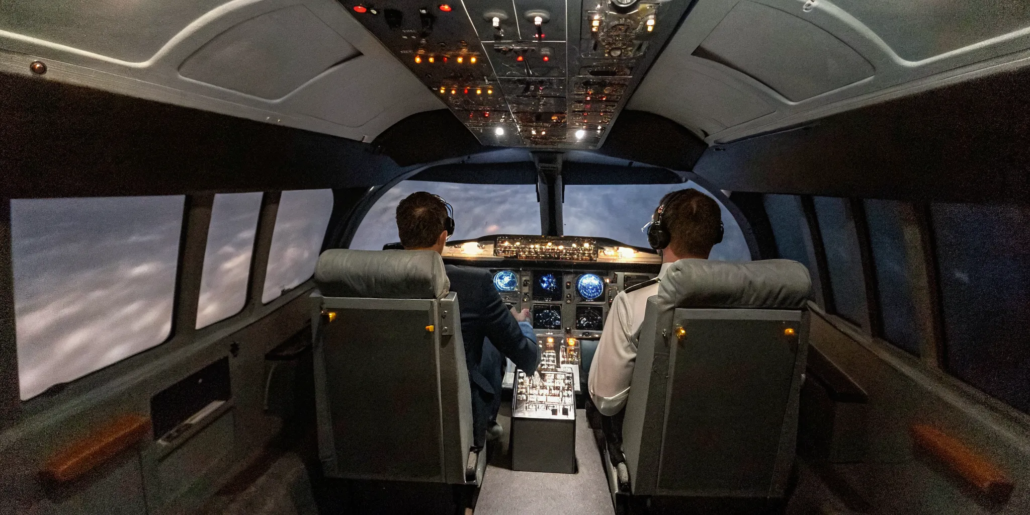
A flight simulator leadership experience is an immersive, team-based workshop where participants execute a simulated mission under realistic pressure: planning, briefing, flying, and debriefing as a cohesive unit. The simulation creates a controlled environment where leadership behaviors, communication habits, and decision-making patterns are exposed in real time. It’s not about learning to fly an aircraft. It’s about learning to lead when the pressure is on and the variables are complex.
Think of it this way. In business, you can’t afford to stress-test your team’s execution when millions of dollars and real client relationships are on the line. A simulator compresses the learning cycle. Your team can fail, diagnose the failure, and apply the fix, all in a matter of hours, not quarters. That compression is the real value.
How a Flight Simulator Builds Leadership Muscle
Make Decisions When It Counts
In the cockpit, when an alarm blares and multiple warning lights flash, you do not have time to form a committee. You assess, you weigh, you call it. Now. In business, we call that analysis paralysis: the fear of making the wrong choice leading to no choice at all. A simulator breaks that pattern by putting your leaders in environments where indecision has immediate, visible consequences.
Here’s the thing. In the fighter pilot community, we train for this by sitting on our hands. Literally. When a fire warning light illuminates, the trained response is: don’t do anything for ten to fifteen seconds. Think. Is it real? Is it a false alarm? What does the data say? Then act. Not react, but respond. That gap between stimulus and response is where good decisions live. The simulator builds that muscle.
Develop Situational Awareness
A pilot can’t just focus on the horizon. You’re monitoring instruments, checking fuel, communicating with your wingman, keeping an eye on the threat environment, all simultaneously. That’s what we call SA, situational awareness. It’s a perception that’s cheap in hindsight but extremely rare and valuable in foresight.
For a business leader, SA means holding the big picture while managing the details. It means understanding how your decisions impact the team, the customer, and the mission, not just the task in front of you. The simulator trains this by overwhelming you with data and forcing you to prioritize. You learn to see the forest and the trees at the same time. That skill is the foundation of effective strategic planning.
Adapt When the Mission Changes
Every leader knows that even the best-laid plans fall apart. Mike Tyson said it best: “Everybody has a plan until they get punched in the mouth.” In our world, we add: “Plan to get punched in the mouth.”
In FLEX, FLawless EXecution, our methodology engineered from the fighter pilot community, we build contingency planning into every mission through the BRIEF mnemonic. The F stands for Flexibility: walk through the “what ifs” so the team knows the response before the surprise arrives. A simulator tests that flexibility by introducing unexpected variables mid-mission. A target moves. A new threat appears. The original plan becomes obsolete.
This is where your team learns that being committed to the mission’s success matters more than being committed to the original plan. That agility is a core component of our 90-Day Accelerator program.
How Flight Simulators Forge Stronger Team Communication
Clear communication is the engine of high-performing teams, and it’s the first thing to break down under pressure. How often have you seen a project go sideways because of a missed update, an unasked question, or a role that nobody clearly owned? In my experience, and I’ve worked with thousands of teams across dozens of industries, the answer is: constantly.
Practice Communication That Actually Sticks
In a simulated mission, your team isn’t just talking. They’re communicating to survive. They must share critical information, coordinate complex actions, and make split-second decisions together. The pressure is real, but the risks are not. That’s the sweet spot.
A peer-reviewed study on simulation-based leadership training found that participants who trained through simulated scenarios strengthened their interpersonal communication skills and recognized the importance of listening to other perspectives before forming their own positions. The researchers concluded that simulation is a powerful pedagogical tool for developing leadership competencies, decision-making, and teamwork. That tracks with what I’ve seen across thousands of teams. Your people learn to deliver bad news clearly, ask for help without hesitation, and provide updates that are concise and actionable. This isn’t role-playing in a conference room. It’s building muscle memory for clear communication under pressure.
Clarify Roles and Align the Team
Ambiguity is the enemy of execution. When people are unsure of their roles, you get duplicated effort, missed tasks, and frustration. In our BRIEF process (Big picture, Restate the mission objective, Identify threats and resources, Execution: who does what by when, Flexibility: contingencies) the rule is non-negotiable: nobody leaves with unanswered questions.
A simulated mission forces absolute role clarity. Each team member has a specific function, and the mission’s success depends on everyone executing their part. The simulator makes it immediately obvious where the handoffs break and how each person’s actions impact the rest of the team. These immersive team building experiences move communication from a theoretical concept to a practiced, mission-critical skill.
Build Trust That Actually Holds
Trust isn’t built during the good times. It’s forged when things go wrong. In the fighter community, we have a concept called the Wingman principle: no one flies alone. Your Wingman is your peer accountability partner, the person who sees what you can’t when you’re focused on the mission. It’s not a manager-report relationship. It’s a partnership of equals committed to each other’s success.
A flight simulator creates the environment where that trust is tested and earned. When your team successfully navigates a simulated crisis together, they don’t just feel relief. They build genuine confidence in each other’s judgment under pressure. That’s the kind of trust you can’t manufacture at a happy hour.
The Debrief: Where the Real Work Happens
Let me tell you something that might surprise you. The flight simulator mission is thrilling, but it’s not where the most important work gets done. The real transformation happens after you land.
In the fighter pilot community, we say the mission is not over until the debrief is over. After landing, we don’t grab a coffee and move on. We go to the Vault, the secure squadron building, and watch the mission tape from start to finish. Every vector, every decision, every radio call. The transition from what I think happened to what actually happened. Some days, the gap between those two things is significant.
The ORCA Engine
The debrief runs on a structure we call ORCA: Objective, Result, Cause, Action.
O, Objective. Did we do what we set out to do? Binary answer. Yes or no. If it’s ambiguous, the objective was never clear enough, and that’s already a lesson.
R, Result. What actually happened? Not what we think happened. Not what we hoped happened. What the data shows.
C, Cause. What was the root cause of the gap between the objective and the result? This is where most business “post-mortems” fall apart. They identify symptoms and stop. ORCA digs to the root.
A, Action. What’s the one thing we change for next time? Not a laundry list. One actionable fix that feeds directly into the next mission’s plan.
The governing principle: it’s not who’s right, it’s what’s right. The Blue Angels set the standard here. Their lead pilot stands up first and owns their errors in front of the whole team. When the leader does this, every person in the room understands that owning a result is what’s respected. The conversation shifts from self-protection to shared diagnosis.
Why Most Organizations Never Debrief
I’ve walked into hundreds of organizations. Not one has had a debrief culture. Zero. That’s not hyperbole. It’s what we’ve found consistently at Afterburner.
Most teams skip the debrief because it feels like a luxury they can’t afford. They jump from one urgent task to the next, never pausing to analyze why they succeeded or failed. They mistake activity for progress.
Here’s the cost. During Operation Rolling Thunder between 1965 and 1968, US forces lost roughly 900 aircraft. Lessons were not being captured, shared, or translated into tactics at scale. After the military institutionalized the structured debrief, through formalized tactics development, rigorous training, and objective brief-and-debrief practices, the results during Operation Linebacker in 1972 were dramatically different. Total aircraft losses dropped to approximately 134, despite facing a denser and more lethal air defense environment. A 400 percent improvement in kill ratio. A 650 percent reduction in losses in a tougher environment. All from a better learning process.
The question I always ask leaders: how many conversations are you having in your business delivering that kind of impact?
Turn a Single Event into an Operating Rhythm
A single debrief is useful. A consistent rhythm of debriefing is transformational. When you make debriefing a non-negotiable habit, you install a sustainable operating system for performance.
In FLEX, the debrief feeds directly into the next plan. Each cycle is sharper than the last. One percent better doesn’t sound like much. But compounded daily, it doesn’t make you 365 percent better by year’s end. It makes you thirty-seven times better. Small, intentional improvements done consistently demolish big, sporadic efforts. Fighter pilots call this the accelerated learning curve, and it’s what separates dynasties from also-rans.
Without FLEX, experience accumulates but doesn’t compound. Wins are wasted because no one knows how to repeat them. Mistakes recur because no one analyzed the cause. FLEX is the system that turns every mission into a deposit in the performance bank and every debrief into interest. It’s a core component of our 90-Day Accelerator, where we help leaders install these rhythms to drive measurable results.
Choosing the Right Experiential Leadership Program
When you’re ready to invest in an experiential program, don’t get seduced by the flashy descriptions. Focus on the methodology underneath. Here’s what to look for.
First, does it align with your specific business goals? A great program should be tailored to address the execution and leadership challenges your team is facing right now, not a generic experience that could apply to anyone.
Second, how will the skills transfer back to the workplace? The most effective programs don’t end when the event is over. They provide a concrete framework, a method your team can apply on Monday morning. Research on advanced flight simulators in pilot training confirms that simulation-based training develops decision-making skills and stress-management capabilities that transfer directly to real-world performance.
Third, and this is the one most programs miss, is there a structured debrief? If the program doesn’t teach your team how to analyze their own performance and feed those lessons into the next mission, you’ve bought an experience, not a system.
The Top Gun Experience by Afterburner
This is exactly why we built The Top Gun Experience. It’s not just a flight simulation. It’s an immersive mission where your team learns to apply the principles of Flawless Leadership℠ and our Flawless approach to execution in a high-consequence environment.
Your team won’t just react to pop-up threats. They’ll build a mission plan using our Six-Step Mission Planning Process. They’ll brief it using the BRIEF mnemonic, ensuring everyone understands not just their own role but how their actions interact with everyone else’s. They’ll execute it in the face of dynamic challenges designed to test communication, adaptability, and accountability.
And then the most critical phase: the Debrief. Using ORCA, your team will analyze their performance, identify the root cause of any errors, and create a plan to improve. The lessons become tangible. The team builds a shared commitment to a higher standard of execution. They leave not just with a memorable experience, but with PBED (Plan, Brief, Execute, Debrief) as a practical tool they can use immediately on their most important projects.
Related Articles
Frequently Asked Questions
Is a flight simulator team event just entertainment, or does it deliver real business results? The simulation is engaging, but its primary purpose is business impact. Think of the simulator as a diagnostic tool where your team’s communication, decision-making, and execution habits are revealed under realistic pressure. The real value comes from using Afterburner’s ORCA debrief framework to analyze that performance and connect it directly to your organization’s goals, turning a memorable day into a measurable improvement in how your team operates.
My team works in business, not aviation. How are flight simulator skills relevant to us? The simulator is not about learning to fly. It’s about learning to lead when the stakes are high, the information is incomplete, and the plan is falling apart. Managing a crisis, adapting to sudden changes, communicating with absolute clarity under pressure: these are universal leadership challenges. Christian “Boo” Boucousis, CEO of Afterburner, spent twenty years applying the same fighter pilot frameworks to industries including hospitality, publishing, logistics, and healthcare with consistent results.
How do the lessons from a simulator actually transfer back to daily work? Transfer happens because the experience teaches a repeatable framework, not just insights. Your team learns PBED (Plan, Brief, Execute, Debrief), a closed-loop system where each cycle feeds learning into the next. The goal isn’t a single insightful day. It’s to install a new operating rhythm, what Afterburner calls FLEX (FLawless EXecution), that makes clear communication and continuous improvement a regular part of how your team works.
What makes the Afterburner experience different from other leadership training programs? Most programs focus on theory, telling you what to do. The Afterburner experience focuses on application, letting you practice how to do it under pressure and then debriefing the results using a structured process. The combination of immersive execution and disciplined debrief creates deeper, more lasting impact than passive learning. It’s the difference between reading about leadership and actually practicing it.
What exactly is the “Debrief” and why is it so important? The Debrief is a structured, blame-free conversation that happens immediately after the mission. It uses the ORCA framework (Objective, Result, Cause, Action) to analyze what happened, identify root causes, and create a specific action for improvement. It’s important because this is where learning solidifies. Fighter pilots have been debriefing this way since 1969, and the results speak for themselves: a 400 percent improvement in combat effectiveness after Top Gun institutionalized the structured debrief. In business, the debrief is the engine that prevents your team from repeating the same mistakes and drives compound growth over time.
Published by Afterburner | Christian “Boo” Boucousis, CEO