

5 Proven Benefits of Simulation Based Team Building
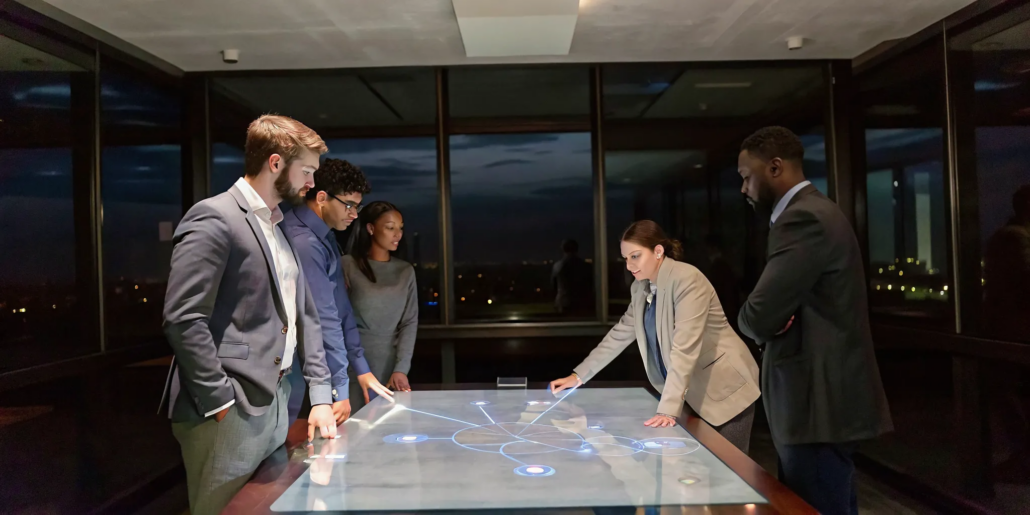
Benefits of Simulation-Based Team Building That Stick
Key Takeaways
- Realistic practice closes the knowing-doing gap. Simulation-based team building puts your team into scenarios that mirror real business pressure, so they build muscle memory instead of just taking notes.
- The Debrief is where real improvement happens. The simulation creates the experience, but the structured, nameless-and-rankless ORCA Debrief is what turns that experience into permanent behavioral change.
- One-and-done training is a waste of money. Lasting performance requires a repeatable system (Plan, Brief, Execute, Debrief), not a single offsite and a hope that something sticks.
I was 22 years old, strapped into an F/A-18 Hornet, processing hundreds of data inputs from three screens, a helmet, four radios, and a wingman, all at over 1,260 miles per hour. And here’s the thing that surprises people: when everything was working, when I was trained and prepared and locked in, it felt like slow motion. Like a John Wick scene where the bullets are moving through honey. That’s what proper preparation does. It doesn’t speed you up. It slows the world down.
The benefits of simulation-based team building come from that same principle. When your team has practiced navigating pressure, making decisions with incomplete information, and communicating under the clock before the real stakes hit, they perform with a clarity that looks effortless. It’s not talent. It’s training. And it’s the same methodology fighter pilots have used for decades to achieve a 99.998% mission success rate.
I’m Christian “Boo” Boucousis, CEO of Afterburner and a former Royal Australian Air Force fighter pilot. I’ve spent the last 20 years applying the methods I learned in the cockpit to business teams across hospitality, publishing, logistics, and healthcare. The method is called FLEX (FLawless EXecution), and it’s built on a simple, repeatable cycle: Plan, Brief, Execute, Debrief (PBED). Simulation-based team building is PBED in action, compressed into a high-intensity experience that rewires how your team operates.
Let me tell you why it works and, more importantly, why most team building doesn’t.
What Is Simulation-Based Team Building?
Think of it as a practice field for the high-stakes game of business. Instead of sitting in a conference room talking about teamwork, your people are dropped into a carefully designed scenario that mirrors the pressures and complexities they face every day. They must communicate, make decisions, and execute a plan together, under pressure, against the clock, with consequences for getting it wrong.
This isn’t trust falls. This isn’t marshmallow towers. This is objective-driven, mission-focused collaborative learning tied to action, not memorization.
In our Top Gun Experience, for example, teams don’t just hear about fighter pilot concepts. They apply them in a fast-paced planning and execution cycle where success depends on every person understanding their role and communicating with precision. The simulation replicates the cross-functional friction that stalls progress in the corporate world, but in a controlled environment where the cost of failure is learning, not revenue.
Here’s the critical distinction from traditional training: in a simulation, instead of just talking about communication, your team has to communicate clearly to succeed. Instead of a worksheet on decision-making, they have to make time-sensitive choices with real consequences inside the exercise. That gap between knowing what to do and being able to do it under pressure? That’s the gap simulation closes.
Why Most Team Building Doesn’t Stick
Let me be direct. I’ve walked into hundreds of organizations over the past two decades, and the story is almost always the same. They did a team-building day. Trust falls, raft building, maybe an escape room. For a moment, everyone felt connected. Monday morning rolled around, and it was back to the same silos, the same communication breakdowns, the same finger-pointing when a project went sideways.
The good vibes evaporated because good vibes aren’t a system.
The One-and-Done Trap
The biggest reason team-building efforts fall flat is they’re treated as a single event. A yearly offsite or a quarterly happy hour is a nice perk, but it won’t change how your team collaborates when they hit a tight deadline with a difficult client. In our world, we call this the one-and-done trap, and it’s like going to the gym once and expecting to be fit for the year.
Real improvement requires a repeatable process. In the cockpit, we don’t train once and call it good. As I wrote in The Afterburner Advantage, “FLEX represents a culture where training is not a one-time event but a career-long endeavor of curiosity.” Research on simulation training confirms this: to truly change teamwork habits, training must be a long-term and repetitive process. Your team needs a shared framework they can use every day, not just a memory of a fun afternoon.
The Low-Stakes Problem
The other failure point is the disconnect between the training activity and the reality of your team’s work. Building a tower out of marshmallows is a fine icebreaker, but it doesn’t prepare your team for a product launch with six dependencies and a client who changes scope on a Thursday afternoon.
The skills practiced in low-pressure, abstract environments rarely transfer to complex, high-pressure situations. When the stakes are low, it’s easy to collaborate. The real test is how the team performs when the pressure is on and the plan starts to fall apart. Simulation closes that gap by making the practice feel like the real thing.
The Real Benefits of Simulation-Based Team Building
When you move beyond abstract exercises and into a high-stakes simulation, the benefits aren’t just about morale. They’re about building tangible skills that affect your bottom line.
Sharper Communication Under Pressure
I’ve seen it happen in every organization I’ve worked with. A project goes sideways, and suddenly clear communication evaporates. Under pressure, people revert to their individual habits: assumptions, jargon, incomplete handoffs. Research shows that simulation-based training fosters collaborative learning and improves how teams communicate by forcing them to refine those skills in a controlled, high-pressure environment.
In the cockpit, we had a mnemonic called BRIEF: Big picture, Restate the objective, Identify the threats, Execution plan, Flexibility. It’s a standardized way to make sure what you say is what the other person understands. Simulation is where your team learns to build that kind of communication discipline, not by reading about it, but by needing it to succeed.
Stronger Cross-Functional Collaboration
Silos are expensive. When marketing doesn’t talk to sales, or engineering doesn’t understand the constraints of operations, you create friction that slows everything down. Simulations break down these walls by design. They create scenarios where success is impossible without genuine cross-functional teamwork.
Here’s the thing: practicing teamwork in a realistic setting helps team members better understand each other’s roles and responsibilities. That shared understanding is the foundation of real collaboration, turning a group of individual contributors into a cohesive unit focused on the same High-Definition Destination (HDD).
Faster, More Confident Decision-Making
Hesitation can be just as damaging as a bad decision. In fast-moving markets, you cannot afford analysis paralysis. Simulation gives your team a training ground for making choices under pressure with incomplete information, just like in the real world.
Fighter pilots don’t go into a mission hoping nothing goes wrong. We go in having already decided what we’ll do when something does. Neuroscience backs this up: mental rehearsal and visualization strengthen neural pathways with the same precision that physical training builds muscle memory. Peter Gollwitzer’s research on implementation intentions, published in the American Psychologist (1999), demonstrates that when people form specific “if-then” plans, they act with remarkable decisiveness in complex environments. Simulation gives your team the repetitions needed to build that kind of judgment.
A Safe Space to Fail and Learn
In business, failure can cost revenue, customers, and morale. But failure is also one of the most powerful teachers. Simulation creates a psychologically safe space to experiment, take risks, and even fail, without putting the company or anyone’s career at risk.
I was a pimply-faced 19-year-old with no college education when I started officer training. Three years later, I was flying the F/A-18 Hornet. That didn’t happen because I was special. It happened because the Air Force put me through thousands of simulated scenarios where I could make mistakes, learn from them, and build confidence before the real stakes kicked in. The same principle applies to your team. A failed simulation mission becomes valuable data for learning, not a mark against anyone’s performance review.
The Debrief: Where the Real Learning Happens
Here’s what most people get wrong about simulation-based training: they think the simulation is the point. It’s not. The simulation creates the experience. The Debrief is where you extract the learning.
In the Royal Australian Air Force, a mission is not over until the debrief is over. Full stop. We didn’t get out of the jet and say “great mission,” because we didn’t know that yet. We walked straight to the debrief room, watched the mission tape, and examined what actually happened versus what we intended.
Without a proper Debrief, a simulation is just an interesting experience. With one, it becomes a tool for rewiring how your team plans, communicates, and executes.
ORCA: The Four-Step Debrief Framework
At Afterburner, the Debrief runs on a framework called ORCA (Objective, Result, Cause, Action).
Objective: What did we set out to do? Restate the mission objective exactly as it was defined. Then ask the binary question: did we achieve it? Yes or no. In our experience facilitating tens of thousands of corporate debriefs, roughly 83% stall at this step because the objective was never clear enough to answer yes or no.
Result: What actually happened? Facts, not feelings. What was done, not done, or done incorrectly? Build the complete picture before anyone starts interpreting it.
Cause: Why was there a gap? This is the critical step. Trace the root cause to a specific person or process, not “the market” or “bad timing.” A decision someone made. The governing principle: it’s not who’s right, it’s what’s right.
Action: What specifically will we do differently next time? One strong action that gets implemented is worth more than ten that get documented and forgotten. And here’s the step that closes the full FLEX loop: every ORCA action feeds directly into the next plan. If the action doesn’t make it into the next plan, it doesn’t exist.
Nameless and Rankless: The Culture That Makes It Work
ORCA only works in the right culture. When you walk into the debrief room, rank and insignia go into a tray at the door. General, colonel, or brand-new wingman: inside that room, everyone has an equal obligation to the truth. No one is protected by their rank from being held accountable to the facts. And no one is too junior to raise the observation that changes how the whole team operates tomorrow.
The New York Giants were one of the lowest-performing NFL teams before Coach Tom Coughlin brought in Afterburner to implement the fighter pilot debrief during the 2011-12 season. Coughlin had read our book Flawless Execution and liked what he saw, particularly the nameless-rankless approach. As he told The Wall Street Journal, “I thought the players would relate to fighter pilots.” Players started openly owning their mistakes week by week, learning together, growing 1% per day. That compounding growth delivered a Super Bowl XLVI win over Brady, Belichick, and the Patriots.
According to Afterburner’s internal case studies, The Beer Cartel, an Australian specialty craft beer retailer, grew revenue 400% in a year by committing to daily debriefing. The debrief works in any environment where humans execute a plan and need to improve.
The Bathtub: How to Lead a Debrief That People Come Back To
How you facilitate the debrief matters as much as the content. We use a structure called the Bathtub: start on a high, drop into the detail, finish on a high.
Open by acknowledging what was achieved: “Here were our three objectives. We hit the primary and secondary. Well done.” Then descend: “We didn’t nail objective three. Let’s drill down there.” Run ORCA. Define the actions. Then come back up: “We fell short this week, but we found the root cause and we have a clear action. That’s a good debrief.”
One of our clients runs a gold mine. The mine manager has two metrics: production and safety. After adopting ORCA with the Bathtub closing, his team went from dreading debriefs to requesting them. Production rose. Safety incidents fell. The debrief became the team’s most valuable 30 minutes.
How to Get the Most Out of Simulation Training
Simulation training is an investment. Like any investment, the return depends on how you manage it. Here’s what separates a fun afternoon from a fundamental shift in how your team operates.
Tailor the Simulation to Your Actual Challenges
Generic exercises can be entertaining, but they won’t fix the specific execution gaps holding you back. The simulation must mirror the actual pressures and complexities your people face. Is it a breakdown in communication between sales and operations? A bottleneck in your product development cycle? A well-designed simulation targets these precise pain points.
Involve Every Level
Execution gaps rarely happen in a vacuum. They occur at the handoffs between departments and seniority levels. When a CEO and a project manager go through the same high-pressure scenario together, they develop a shared understanding and empathy that you can’t get from a memo. Research confirms that simulation is effective for teaching teamwork skills across all levels of staff, including experienced leaders.
Make It a Rhythm, Not a One-Time Event
A single day of training will not permanently change behavior. Skills like clear communication, agile decision-making, and flawless execution are like muscles: they require consistent practice. Instead of viewing simulation as a one-off, integrate it into your organization’s operational rhythm. Use regular debriefs to reinforce key principles and tackle new challenges as they arise. This is how high performance becomes the standard, not the exception.
The Afterburner Method: Where Fighter Pilot Meets Boardroom
At Afterburner, we’ve trained more than two million people across 3,500 companies using the same FLEX methodology that fighter pilots use to achieve mission success. Our most immersive simulation, the Top Gun Experience, puts your team into a challenging, time-sensitive mission that requires them to Plan, Brief, Execute, and Debrief to succeed.
This isn’t a passive lecture. Your team builds a plan, communicates it clearly, executes under pressure, and then sits down for a structured ORCA Debrief to extract lessons learned. The simulation is designed to replicate the ambiguity and cross-functional friction that stalls progress in the corporate world, but in a controlled environment where the stakes are learning.
What makes this different from other team-building events is the focus on installing a repeatable process. The goal isn’t just to have a memorable day. It’s to equip your team with a shared language and a simple framework (PBED) they can apply to their very next project. We have an 83% repeat rate with our clients, if that tells you anything.
Frequently Asked Questions
What is simulation-based team building and how does it work? Simulation-based team building is a hands-on, immersive training method where teams are placed into realistic, high-pressure scenarios that mirror their actual business challenges. Instead of passive learning, participants must communicate, make decisions, and execute a plan together under time pressure. At Afterburner, simulations follow the Plan-Brief-Execute-Debrief (PBED) cycle used by fighter pilots, closing with a structured ORCA Debrief to turn the experience into actionable improvement.
How is this different from traditional team-building activities? Traditional team building (trust falls, escape rooms, raft building) is typically a single event with low stakes and no structured follow-up. Simulation-based training is objective-driven, mirrors real business pressure, and includes a formal Debrief process that identifies root causes and creates specific action plans. The difference is between a fun day and a performance system.
Will the skills from a simulation actually stick after the event? The simulation itself is not the final product; it’s a tool to introduce a repeatable framework. Your team doesn’t just have a good day; they leave with the PBED cycle and ORCA Debrief methodology they can apply to every project and meeting going forward. The learning sticks because the framework becomes part of your team’s daily operational rhythm.
Is simulation training only for leadership teams? The training is most powerful when it includes people from different levels and functions. Execution gaps occur at the handoffs between departments and seniority levels. When a senior leader and a frontline specialist go through the same simulation, they develop a shared understanding that breaks down silos and aligns the entire organization.
How do we justify taking time away from work for this? Think of it as a high-leverage investment. The friction, miscommunication, and rework from poor execution cost your team countless hours each week. A simulation provides a compressed environment where your team can fix those execution gaps. By learning to align and communicate more effectively, they save far more time on future projects than they spend in the training.
Christian “Boo” Boucousis is a former Royal Australian Air Force F/A-18 Hornet fighter pilot, CEO of Afterburner, keynote speaker, and author of The Afterburner Advantage and Flawless Leadership℠.

