

The Essential Guide to Business Leadership Training
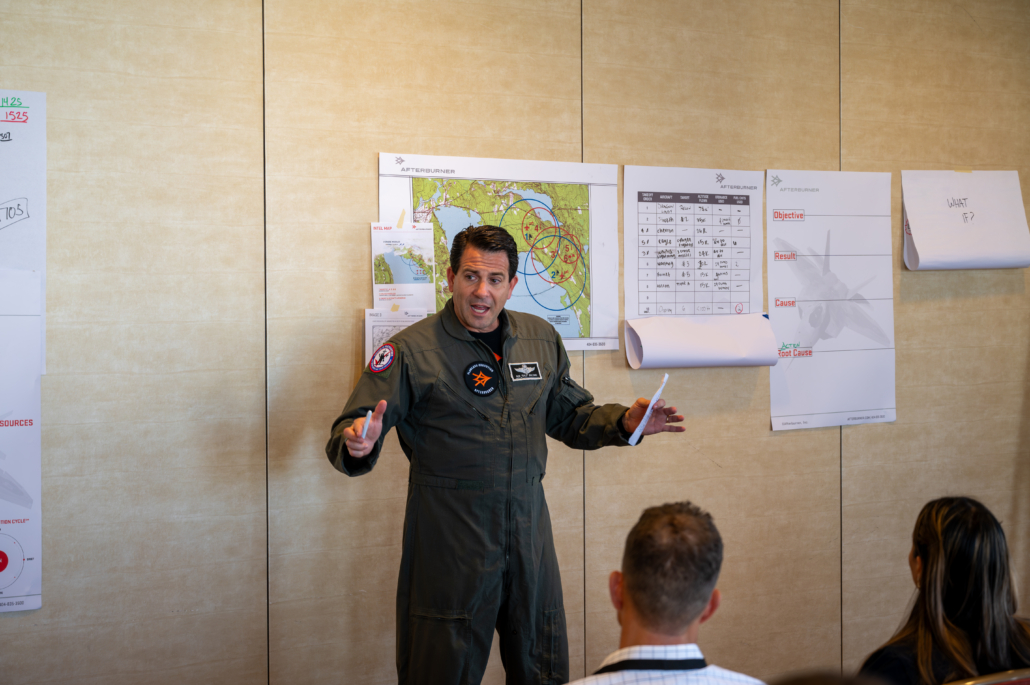
Business Leadership Training: A Fighter Pilot’s Approach to Execution
I was sitting in a boardroom in Perth, Australia, watching a $40 million hotel project come apart at the seams. Twelve managers around the table. Twelve different ideas about what the priorities were, who owned what, and what success even looked like. Sound familiar?
Business leadership training is the process of equipping leaders with a shared, repeatable framework for planning, executing, and improving, so your organization stops relying on individual heroics and starts operating like a team that actually knows the mission. It’s not about personality assessments or trust falls. It’s about installing an operating system that connects your strategy to the actions your people take every single day. That’s what separates organizations that consistently hit their targets from ones that are always scrambling.
I’m Christian “Boo” Boucousis, CEO of Afterburner and a former Royal Australian Air Force F/A-18 Hornet fighter pilot. I’ve spent over twenty years applying fighter pilot methodology to business leadership, and I’ve learned that the gap between a good strategy and great results is almost never talent. It’s method.
Key Takeaways
- Demand an operating system, not a motivational event. Effective leadership training gives your team a shared, repeatable framework they can use the next day, not a binder that collects dust.
- Tie every program to a specific business outcome. Before you sign a check, define the execution gap you need to close. If the training doesn’t connect to measurable results, it’s entertainment.
- Build reinforcement into the design. A single workshop doesn’t change behavior. The best programs install a rhythm of planning and debriefing that turns new skills into daily habits.
What Is Business Leadership Training?
Here’s the thing: leadership isn’t a title. It’s a skill set you practice every day. Business leadership training is the process of sharpening those skills through structured frameworks, applied practice, and continuous feedback. The goal is to move your leaders beyond instinct and gut feelings into a repeatable process for guiding teams, making high-stakes decisions, and executing on a plan with clarity.
Why does this matter? Because inconsistent leadership is expensive. It shows up as missed deadlines, misaligned teams, stalled projects, and a culture where nobody is quite sure what the mission actually is. When execution gaps appear (and they always do) they can almost always be traced back to a breakdown in how the team was led.
In our world, we call this the difference between having a method and just hoping for the best. In the cockpit of an F/A-18, hope is not a strategy. You have a process: you plan, you brief, you execute, you debrief. Every single mission. That same discipline applies in a boardroom, on a sales floor, or inside a startup trying to beat the odds. This is the foundation of our Flawless Execution approach.
Why Most Training Fails Before It Starts
I’ve seen it hundreds of times. A company sends their managers to a workshop. Everyone comes back inspired. By Thursday, it’s forgotten. The problem isn’t motivation. It’s that the training didn’t install anything. No shared language. No framework to apply. No system for reinforcement.
Effective training is built on two pillars. The first is engagement, and I don’t mean icebreakers. With engagement levels at historic lows across most industries, your training has to be interactive, relevant, and connected to the real problems your leaders face right now. The second pillar is a clear connection to business results. According to a study by the Association for Talent Development (ATD), companies with comprehensive training programs have 218% higher income per employee and 24% higher profit margins than companies without formalized training. The training should equip leaders with skills that directly move the needle, creating a clear line between the learning and the bottom line.
From Keynotes to Coaching: What Format Works?
There’s no single format that works for every team. A blended approach is often the smartest play. You might kick things off with a high-energy keynote to introduce new concepts and align the entire organization. From there, interactive workshops let smaller groups apply those concepts to specific challenges: annual planning, cross-functional alignment, closing an execution gap. Immersive team building experiences can simulate high-pressure environments to test decision-making and communication when it counts. And one-on-one or group coaching provides sustained support, helping leaders integrate new frameworks into their daily routines over weeks and months.
The format should serve the learning objective, not the other way around.
What Skills Should Leadership Training Actually Develop?
Too many programs focus on abstract theories. Leaders come back with a vocabulary upgrade but no change in how they operate on Monday morning. The skills that actually drive results fall into four areas, and every one of them maps to what we teach fighter pilots before they ever touch the throttle.
Clear Communication and Emotional Intelligence
In a fighter squadron, unclear communication gets people hurt. The same principle applies in business, just with lower stakes and higher tolerance for ambiguity, which is exactly why it festers.
Effective training teaches leaders to communicate with a clarity that leaves no room for misinterpretation. In our Flawless Leadership℠ program, we use a framework called BRIEF: Big picture, Restate the objective, Identify threats and resources, Execution (who does what by when), and Flexibility (contingencies). The principle is simple: it’s not what you say, it’s what’s understood.
Beyond the mechanics, great leaders develop emotional intelligence, the ability to read a room, understand what motivates individuals, and create an environment where people feel safe enough to speak up, admit mistakes, and collaborate honestly. That psychological safety isn’t soft. It’s the operating condition that makes everything else possible.
Strategic Thinking and Decisive Action
A leader’s primary job is to turn strategy into action. That requires the ability to make clear, decisive calls, even with incomplete information. In the cockpit, we don’t have the luxury of waiting for perfect data. We’re trained to assess, decide, and act with the best information available, then adjust based on what reality tells us.
Effective training should install a framework for this. At Afterburner, we use a method called FLEX (FLawless EXecution) built on a cycle called PBED: Plan, Brief, Execute, Debrief. The planning phase answers six critical questions: What’s the mission? What could stop us? What resources do we have? What have we learned before? Who does what? And what if something goes wrong? By the time a pilot leaves the planning room, every variable has been thought through. The same discipline applies to strategic planning in any organization.
Building Resilient Teams
No leader succeeds alone. Building a high-performing team goes beyond hiring. It’s about creating a culture of mutual accountability and trust. In the fighter pilot world, we train wingmen to watch each other’s blind spots. In business, the concept is identical: surround yourself with people who will challenge your thinking and tell you what you need to hear, not what you want to hear.
Training should give leaders practical tools for delegation, collaboration, and constructive conflict resolution. When disagreements arise (and they will) a trained leader guides the team toward what’s right rather than who’s right. That’s the principle behind our nameless, rankless debrief: rank comes off at the door, and the only thing that matters is the truth. It’s one reason immersive team building experiences create such lasting impact.
Leading Through Change and Uncertainty
The modern business environment is defined by speed and disruption. Leaders must guide their teams through ambiguity without losing momentum. This requires anticipating obstacles, communicating a clear vision, and building the resilience to adapt when reality deviates from the plan, because it always does.
In the cockpit, we call this “flying the brief.” You execute the plan, but you don’t do it rigidly. If something changes mid-mission, you adapt based on what the plan already told you to do (your contingencies) or what the data is telling you in real time. You don’t abandon the plan because it got hard. You deviate only when the evidence tells you to, and you debrief the deviation immediately.
How to Identify a Program That Actually Works
Let me tell you what happened when I walked into that stalled hotel project in Perth. The team didn’t need another motivational speech. They needed a process. They needed to know what the destination looked like, who owned what, and how they’d know if they were winning or losing on any given day. We installed FLEX, and that project, the Rydges Perth King Square Hotel, was completed ahead of schedule and under budget. It became the tallest modular hotel in the world.
That experience reinforced something I already knew from the cockpit: the right methodology beats inspiration every time. Here’s what to look for in a training program.
Actionable Frameworks, Not Theories
A framework is a simple, repeatable process that helps leaders make better decisions under pressure. It provides a mental model for assessing a situation, planning a response, executing with discipline, and learning from the result. If a program can’t hand your leaders a tool they can use the next day, it’s the wrong program. At Afterburner, we define success using a High-Definition Destination (HDD), a crystal-clear picture of the endpoint that is binary: you either arrived or you didn’t. Not “grow the business.” More like “increase market share in mining by 800,000 gallons per month by November 30.” One of our clients built exactly that HDD and hit it in seven months.
Hands-On, Applied Learning
Learning happens by doing. The best programs get participants out of their seats and into simulations, workshops, and real-world problem-solving. When leaders practice new behaviors in a controlled environment, they build the confidence and muscle memory to apply them on the job. Passive lectures produce passive results. Active application produces practical leadership skills that stick.
A System for Continuous Improvement
A one-day workshop is a starting point, not a transformation. True change requires a system for continuous improvement, a consistent rhythm of planning, executing, and debriefing that becomes embedded in your team’s daily operations.
In our world, we call this the ORCA debrief: Objective (did we do what we set out to do?), Result (what actually happened?), Cause (why was there a gap?), and Action (what specifically changes next time?). Every debrief closes with a High Note using what we call D.O.S.E. (Dopamine, Oxytocin, Serotonin, Endorphins) so the team leaves energized, not deflated. When this rhythm is embedded, your team gets one percent better every mission. Compounded daily, that doesn’t make you 365 percent better by year’s end. It makes you thirty-seven times better.
Instructors Who Have Been in the Arena
Who delivers the training matters as much as the content. Look for instructors who have credible experience leading in high-stakes environments, people who have navigated complexity, led teams under real pressure, and been held accountable for outcomes. These aren’t theorists reading from a textbook. They’re practitioners who can translate hard-won lessons into practical advice that resonates, because they’ve lived it.
How to Choose the Right Program for Your Team
Choosing a program isn’t about the flashiest brochure. It’s a strategic investment. The goal is to find a partner who understands your challenges and can install a methodology that outlasts the engagement.
Start with Your Business Objectives
Before you look at a single proposal, get clear on what you’re trying to accomplish. If you want executive buy-in, map the training to the metrics the C-suite cares about. Are you trying to accelerate a growth strategy? Improve cross-functional collaboration? Build a more resilient culture? The right program will be tailored to your specific execution gaps, not a generic curriculum.
Evaluate the Instructors and the Structure
Brilliant concepts fall flat when delivered by someone who’s only read about high-stakes environments. Look for instructors with real-world experience in situations where clear communication and flawless execution were non-negotiable. Beyond resumes, consider the structure: is it interactive? Does it require active participation? The best programs prioritize workshops, simulations, and facilitated discussions over passive lectures.
Understand the Real ROI
Don’t get stuck on the sticker price. The real conversation is about the return. The ATD study found that companies in the top quarter of training investment enjoyed 218% higher income per employee and 24% higher profit margins than those in the bottom quarter. The ROI of effective training shows up in closed execution gaps, faster decisions, higher retention, and the successful completion of strategic initiatives. The cost of doing nothing is almost always higher.
Match the Format to Your Reality
A multi-day offsite might be perfect for your executive team, while a series of virtual workshops could better serve a globally distributed group. The format should accommodate different learning styles and minimize disruption to the business. Whether it’s a keynote to kick off a new initiative or an immersive experience to forge stronger bonds, the delivery method should serve the learning, not the other way around.
Common Challenges (And How to Solve Them)
Most training programs fail not because the content is bad, but because organizations don’t anticipate the roadblocks. They focus on the event and neglect the system around it. Here are the four most common pitfalls and how to get ahead of them.
Measuring ROI
If you can’t measure it, you can’t manage it. The solution starts before the training begins: define the specific business outcomes you want to influence. Instead of vague goals like “better leadership,” target concrete metrics like project cycle times, retention rates, and decision speed. In FLEX terms, set an HDD for the training itself. Make it binary. A strategic planning workshop can help you define those targets before you begin.
Overcoming Resistance
You can have the best content on the planet, but it won’t matter if your team isn’t engaged. To get buy-in, connect the training directly to a business problem the audience already feels. For participants, the experience has to be interactive and relevant. People engage when they see themselves in the scenario, not when they’re taking notes on slide forty-seven.
Building Accountability
Many programs fail because there’s no system to hold people accountable for applying what they’ve learned. The training ends, everyone gets a certificate, and it’s back to business as usual. At Afterburner, we solve this with the X-Gap, the Execution Gap analysis. The debrief fixes today’s mission. The X-Gap examines the pattern across twenty missions. It asks whether the tactics are working, whether the strategy itself needs to change. Weekly, monthly, quarterly: the cadence creates a feedback loop that makes improvement unavoidable. This is central to our Flawless Execution approach.
Making the Learning Stick
The “one and done” workshop is a recipe for forgotten lessons. For learning to stick, it needs reinforcement over time. Follow-up sessions, coaching, and practical application tools help leaders integrate new frameworks into their actual work. Comprehensive programs like our 90-Day Accelerator are designed to turn learning into habit, ensuring the initial spark becomes sustained performance improvement.
What Results Should You Expect?
When you equip your leaders with a practical, repeatable method for execution, the effects ripple outward across three levels.
Immediate: Sharper Skills, Greater Confidence
The most immediate result is a shift in individual capability. When leaders learn a framework they can apply the next day, uncertainty gives way to clarity. This confidence doesn’t come from positive thinking. It comes from having a reliable process (FLEX) to fall back on when the pressure rises. Instead of guessing, leaders have a clear method for making decisions, communicating priorities, and leading their teams through ambiguity.
Team-Level: Alignment and Execution
When individual leaders start using the same operating system, the impact on teamwork is profound. A shared framework creates a common language that cuts through friction and gets everyone pointed at the same destination. Planning sessions get sharper. Handoffs get smoother. Accountability becomes clear. This is what closes the gap between your strategy and your actual results: flawless execution as a daily discipline, not a slogan.
Long-Term: A Culture of High Performance
The ultimate goal is a culture where FLEX isn’t something you do in a training room. It’s how your organization operates. When planning, briefing, executing, and debriefing become the default rhythm, your entire company becomes a learning machine. Every mission is a deposit in the performance bank. Every debrief is compound interest. That’s the Afterburner Advantage.
Related Articles
Frequently Asked Questions
How is fighter-pilot-based leadership training different from standard management courses? Most management courses teach theories and personality models. Our approach installs a practical operating system, FLEX (FLawless EXecution), built on a repeatable cycle of Plan, Brief, Execute, Debrief. The goal isn’t to understand leadership concepts in the abstract. It’s to give your team a shared process for turning strategy into action, especially when the pressure is on. Every framework we teach was originally designed for environments where the margin for error is measured in fractions of a second.
Is leadership training only valuable for new or struggling managers? Not at all. While it provides a critical foundation for emerging leaders, it’s equally valuable for seasoned executives. Experienced leaders often operate on instinct, which works for them individually but is nearly impossible to scale. A structured framework like FLEX helps them translate those instincts into a teachable method, creating consistency across the entire organization. It gives your leadership team a common language and a shared rhythm for execution.
How do you prevent training from being just a temporary motivational boost? Lasting change comes from building a system, not just attending an event. A one-off workshop can spark insight, but the learning fades without reinforcement. Effective programs embed a rhythm of planning and debriefing (what we call the PBED cycle) into your team’s daily work. The X-Gap analysis reviews patterns across multiple missions, ensuring continuous improvement becomes structural, not aspirational. Programs like our 90-Day Accelerator are specifically designed to make this transition.
Can this work for geographically distributed teams? Absolutely. The core of the training is the shared framework. FLEX creates alignment whether your team is in one room or spread across time zones. We deliver through multiple formats: virtual workshops for distributed groups, high-energy keynotes for company-wide alignment, and immersive in-person experiences for key teams. The methodology doesn’t depend on physical proximity. It depends on a shared commitment to the process.
How do you measure the success of a leadership training program? Not by satisfaction surveys. Success should be measured by impact on the business. Before starting, identify the specific outcomes you want to influence: project cycle times, cross-functional alignment, employee retention, decision speed, or revenue per employee. Set an HDD (a High-Definition Destination) for the training itself. Make it binary: did we arrive, or didn’t we? The right program is a strategic tool, and its value is reflected in the measurable improvement of the indicators that matter most to your organization.