

Top Corporate Training Companies That Drive Real Results
Corporate Training Companies: How to Pick One That Actually Works
I’ve watched this movie a hundred times. A company invests in a training program. The team goes offsite for a day or two. The speaker is engaging. The energy is high. People scribble notes in branded binders. They fly home feeling inspired. Three weeks later, nothing has changed. The binder sits on a shelf. The old patterns are back. The investment produced a nice experience and zero lasting impact.
What separates an effective corporate training company from one that just puts on a good show? One thing: whether they install a system that changes behavior, or whether they deliver an event that changes mood. Mood fades. Systems compound.
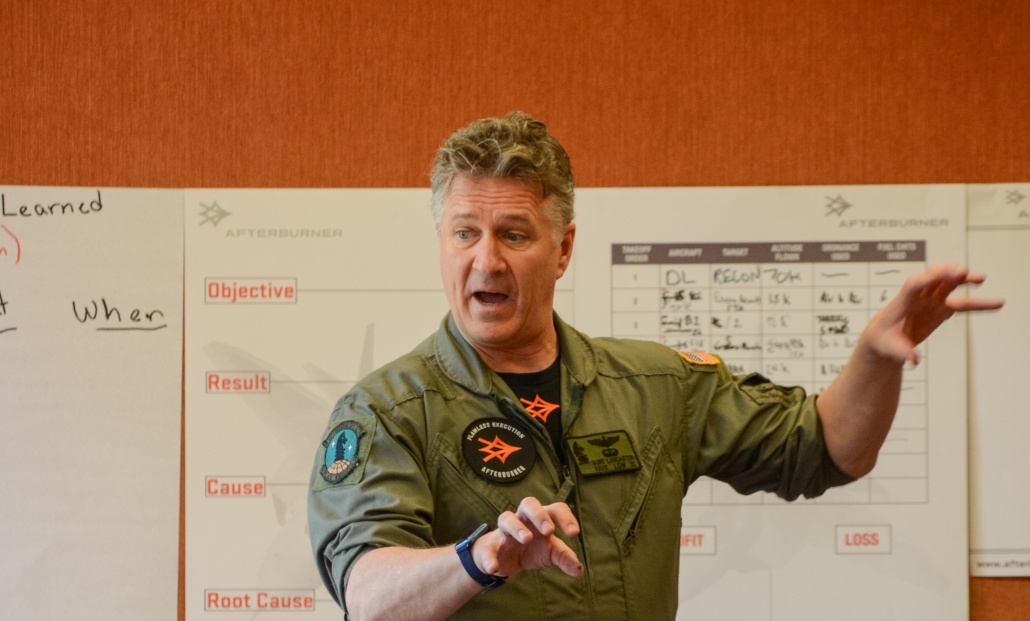
I’m Christian “Boo” Boucousis, CEO of Afterburner. Former Royal Australian Air Force F/A-18 Hornet fighter pilot. I’ve spent twenty years applying fighter pilot methodology to business, and I bought Afterburner in 2024 because I believe the gap between strategy and execution is the single biggest problem in business. Since 1996, we’ve trained over 2.2 million people across 94% of the Fortune 1000, with an 85% repeat client rate. That repeat rate tells you everything. Companies don’t come back because the event was fun. They come back because the framework worked.
This article is a practical guide to choosing a corporate training partner that actually delivers. I’ll walk you through what to look for, what to avoid, how to measure whether it’s working, and how the major players compare. Yes, Afterburner is one of those players. I’ll be transparent about what we do and where we fit.
What Separates an Effective Training Company from the Rest?
Here’s a number that should bother every leader spending money on corporate training: US companies spend somewhere between $1,283 per employee on workplace learning annually. The return? Global employee engagement fell to 21% in 2024, down from 23% the year before. The spending isn’t the problem. It’s where the spend is pointed.
Most corporate training addresses behavior. It teaches people what to do differently without addressing why they can’t. In Flawless Leadership℠, I call this trying to fix the user interface without updating the operating system. It’s like buying running shoes for someone with a broken leg.
The partners who actually move the needle share four characteristics.
They Change Behavior, Not Just Knowledge
A great training program isn’t measured by how much your team enjoyed the session. It’s measured by what they do differently the next day, the next week, and the next quarter. The most effective training companies are obsessed with behavior change. They understand that knowledge alone doesn’t produce results. Consistent action does.
Instead of teaching concepts, they provide simple, repeatable frameworks that people can apply immediately. In the FLEX (FLawless EXecution) framework, that means giving teams a common operating language for how they Plan, Brief, Execute, and Debrief (PBED). Not a theory to remember. A system to use.
They Align Training to Your Specific Business Problems
One-size-fits-all training rarely fits anyone. A premier partner acts like a consultant first, investing time to understand your organization’s unique challenges and strategic priorities before recommending a solution. They identify the specific execution gaps holding you back and design a targeted intervention to close them.
Whether you’re trying to accelerate a new strategy, improve cross-functional alignment, or develop your next generation of leaders, the program should be tailored to that exact goal. At Afterburner, we’ve customized our workshops for industries from healthcare to hospitality, packaged goods to professional sports. The methodology is always FLEX. The application is always specific to the client’s real-world problems.
They Measure Impact, Not Satisfaction
“How will we know this worked?” Any serious training partner should answer that question with confidence before you sign a contract. Vague promises of “improved morale” aren’t enough.
The Kirkpatrick Model is the gold standard for training evaluation. It assesses impact at four levels: Reaction (did participants find it valuable?), Learning (did they acquire new skills?), Behavior (are they applying those skills on the job?), and Results (what business outcomes improved?). Most training companies only measure Level 1. The good ones measure all four. Demand that from any partner you evaluate.
They Make the Learning Stick
The critical phase of any training program isn’t the event itself. It’s what happens when your team goes back to their desks and faces the same pressures that created the old habits. Leading training companies build reinforcement into their programs. They don’t deliver an event and disappear. They provide follow-up coaching, progress checks, and tools that help teams continue developing.
At Afterburner, our 90-Day Accelerator is built on exactly this principle: sustained practice over three months that embeds the FLEX cadence into your organization’s operating rhythm. Because a framework only works if you use it. And you only use it if someone holds you accountable during the transition from learning to habit.
10 Corporate Training Companies That Drive Results
Every partner brings a different philosophy. Here’s an honest look at the major players, including where each fits best.
1. Afterburner
Full disclosure: this is my company. Afterburner translates the FLEX (FLawless EXecution) framework, derived from fighter pilot methodology, into practical tools for business. Our approach is built on a simple, repeatable cycle: Plan, Brief, Execute, Debrief. We don’t teach abstract theory. We install an operating system for execution through hands-on workshops, keynotes, and the 90-Day Accelerator.
A 2012 study by the Group for Organizational Effectiveness reviewed 46 studies on debriefing across business, medicine, and aviation. Properly conducted debriefs improved team and individual performance by 20-25%. Structured, disciplined debriefs improved performance by 35-40%. That’s the engine behind everything we do.
We’re the right fit if your problem is the gap between strategy and results. We’re not the right fit if you’re looking for a digital learning library or a compliance training platform.
2. Dale Carnegie Training
With a legacy spanning over a century, Dale Carnegie focuses on interpersonal skills, confident communication, and relationship-building. Their programs develop leaders who can inspire action, handle difficult conversations, and build collaborative teams. Particularly strong for emerging leaders and managers building foundational people skills.
3. FranklinCovey
Best known for The 7 Habits of Highly Effective People, FranklinCovey builds programs around principle-centered habits. Their highly structured content is consistent worldwide, making them a strong choice for large global organizations wanting a uniform approach to effectiveness. Ideal for companies that need a common leadership language based on proven principles.
4. The Ken Blanchard Companies
Known for their Situational Leadership model, Blanchard teaches leaders to adapt their style based on their team members’ development level. Their programs emphasize flexibility and empowerment, helping create a more motivated and self-reliant workforce. A natural fit for organizations focused on coaching culture and employee engagement.
5. Center for Creative Leadership (CCL)
CCL brings a research-heavy approach backed by over 50 years of academic study. They use assessments and data-driven insights to help leaders understand their strengths and development needs. Their programs are often geared toward senior and executive leaders. A strong choice for organizations that value rigorous, evidence-based development.
6. Skillsoft
A leader in digital learning, Skillsoft offers a vast library of on-demand online training across leadership, technology, and compliance. Excellent for organizations that need scalable, flexible training for a large and dispersed workforce. Ideal for building a culture of continuous, self-directed learning.
7. GP Strategies
GP Strategies offers comprehensive, customized solutions spanning leadership development, technical skills, and sales enablement. Their strength is managing entire learning ecosystems at scale, from content creation to technology and administration. Best for companies needing a versatile partner for diverse, enterprise-wide training needs.
8. Development Dimensions International (DDI)
Built on decades of leadership science research, DDI focuses on helping organizations hire, promote, and develop leaders at every level. They use assessments and simulations to identify high-potential talent and equip them for critical transitions. A great fit for organizations prioritizing a data-driven approach to talent management and succession planning.
9. BTS
BTS specializes in experiential learning through custom-built business simulations and hands-on exercises. Their “learning by doing” method connects actions to business outcomes, making lessons memorable and immediately applicable. Ideal for organizations that want to move beyond traditional classroom learning into truly interactive development.
10. Wilson Learning
Wilson Learning works at the intersection of leadership, sales performance, and workforce engagement. Their programs develop leaders who coach effectively and sales teams that build lasting customer relationships. A strong choice for businesses connecting leadership development directly to revenue growth and retention.
What Types of Programs Are Available?
Think of the different program formats as tools in a toolkit. Each solves a different problem.
Keynotes and seminars are the spark. A great keynote introduces a new framework to a large group in a short timeframe. Perfect for annual meetings, sales kickoffs, or leadership offsites where the goal is alignment and momentum.
Immersive workshops are where you build the fire. These are hands-on sessions where teams apply frameworks directly to real business challenges. Our workshops at Afterburner are designed to apply Flawless Leadership℠ directly to your strategic problems. You walk away with a tangible plan, not just notes from a lecture.
Long-term accelerator programs are for lasting change. The 90-Day Accelerator blends workshops, coaching, and real-world application over three months to embed FLEX into your organization’s operating rhythm.
Executive coaching provides confidential, one-on-one support for senior leaders working through complex challenges. The most effective coaching ties directly to business outcomes.
Team-based experiences and simulations drop your team into dynamic scenarios where they must communicate, decide, and execute under pressure. Our team-building experiences are designed to build trust and reveal communication gaps in a safe environment.
Common Pitfalls to Avoid
Choosing the wrong training partner wastes time, budget, and momentum. Here are the traps I see most often.
Letting Price Drive the Decision
The cheapest option is almost never the most effective one. A low-cost program that creates no lasting change is far more expensive than a premium one that solves a core business problem. Frame the conversation around value and expected return, not just the line item on the invoice.
Training That Isn’t Connected to a Business Problem
Training that isn’t tied to a strategic priority is an activity, not an investment. Before you start evaluating providers, get absolute clarity on the problem you’re solving. If a potential partner seems more interested in selling their off-the-shelf solution than understanding your situation, that’s a red flag.
No Plan for Measuring Effectiveness
Many programs feel good in the moment but create no lasting impact. If a partner gets vague when you ask “How will we know this is working?”, keep looking. They should be able to articulate a measurement approach using something like the Kirkpatrick Model before the engagement begins.
No System for Reinforcement
The biggest failure point for corporate training is the lack of a system to sustain momentum after the event. Initial excitement fades, old habits return, and the investment fails to deliver. Any partner you choose should have a structured plan for follow-up coaching, progress checks, and ongoing reinforcement. This is the bridge between learning a concept and embedding it into daily operations.
How to Evaluate Whether the Training Worked
Investing in training without a clear way to measure success is like flying blind. You need a framework to see whether the investment actually moved the needle.
Use the Kirkpatrick Model
The Kirkpatrick Model gives you a complete picture across four levels: Reaction, Learning, Behavior, and Results. Most companies stop at Level 1 (satisfaction surveys). Push to Level 3 (behavioral change) and Level 4 (business outcomes). That’s where the real proof lives.
Tie Training to Business KPIs
Before launching any program, identify the specific metrics you expect to influence: project completion rates, sales cycle length, employee turnover, operational efficiency. Track them before and after. That’s how you move from “the team liked it” to “it produced a measurable return.”
Build Feedback Loops
A single post-event survey captures a snapshot. Build 30, 60, and 90-day check-ins with participants and their leaders. Ask specific questions: What are you applying? What’s working? Where are you stuck? This continuous dialogue reinforces learning and reveals where adjustments are needed.
Track Long-Term Behavioral Change
The true value of any program is determined by whether it creates lasting habits. Are teams who went through the planning workshop now completing projects on time more consistently? Are leaders who received coaching running better debriefs? Track these shifts over months, not days. That’s how you prove sustainable impact.
In the FLEX framework, this is the X-Gap at scale: periodically stepping back to examine whether the overall approach is creating the intended impact. Weekly X-Gaps catch problems early. Monthly X-Gaps fix them before they compound. Quarterly X-Gaps ensure you’re still flying toward the right destination.
How to Maximize Engagement
Even the best program falls flat if participants aren’t engaged. Here’s how to get your team to lean in.
Leadership goes first. When executives actively champion a training initiative, participate in sessions, and model the desired behaviors, it signals that development is a core priority, not an HR checkbox. This is central to Afterburner’s approach: we start by installing the framework at the leadership level, then cascade it down.
Choose applied learning over lectures. Interactive workshops, realistic simulations, and hands-on problem-solving are exponentially more effective than passive lectures. People remember what they do, not what they hear.
Make it part of the operating rhythm. Frame training not as a one-time event but as an ongoing commitment. When the debrief becomes a daily practice and the mission brief becomes the standard for every project kickoff, learning stops being an event and becomes how the organization operates.
Connect it to career advancement. People engage when they see a clear answer to “What’s in it for me?” Tie training directly to career paths and promotion criteria. When employees understand that mastering the framework helps them achieve their personal goals, they shift from passive attendees to active participants.
Related Articles
Frequently Asked Questions
We’ve tried training before and the effects faded quickly. How do we ensure new skills actually stick?
This is the most common frustration I hear. It happens when training is treated as an event rather than a system. To make learning last, you need two things: a simple, repeatable framework and structured reinforcement. The framework gives your team a practical tool they can apply immediately. The reinforcement, including follow-up coaching and progress checks, ensures new behaviors become ingrained habits. At Afterburner, the 90-Day Accelerator is specifically designed to bridge this gap, embedding the FLEX cadence (Plan, Brief, Execute, Debrief) into your team’s daily operations over three months.
How can I justify the cost of a premium training program?
Shift the conversation from cost to return. A low-cost program that creates no lasting change is more expensive than a focused investment that solves a core business problem. A credible partner will work with you upfront to define success and connect the program to your most important business metrics. The justification comes from measurable improvements in performance, not from the price tag. Research shows that properly structured debriefs alone improve team performance by 20-25%, and more disciplined debriefs improve it by 35-40%.
What’s the difference between a program that teaches concepts and one that installs an operating system?
A concept-based program gives your team interesting ideas to consider. An operating system gives them a shared language and a consistent process for turning strategy into action. It changes how teams plan, communicate, and hold each other accountable. Think of it as the difference between reading a book about fitness and working with a trainer who gives you a specific daily workout plan and checks your form every week.
My team is busy and geographically dispersed. How can we implement training without disrupting workflow?
Look for a partner who offers flexible delivery and focuses on applied learning. Effective programs can be delivered through a mix of virtual and in-person sessions. More importantly, the learning should be integrated directly into your team’s actual work. When training involves solving real problems and planning current projects, it becomes part of the job, not an interruption from it.
How soon should we expect to see a return on investment?
Two types of return, at different speeds. First, an immediate shift in alignment and clarity. Teams often leave a strong session with a shared operating language and a clearer plan. Second, the longer-term return comes as they apply the frameworks consistently. You should see behavioral changes (more structured meetings, better debriefs, clearer mission briefs) within weeks. Impact on major business KPIs follows as those new behaviors compound. The X-Gap process (ORCA at scale) is how you track whether the patterns are working over months and quarters.