
Executive Coaching Online: A Practical Guide
Executive Coaching Online: A Fighter Pilot’s Guide to Finding the Right Partner
Key Takeaways
- A framework beats a conversation every time. The best executive coaching online is built on a repeatable system for closing execution gaps, not just motivational dialogue. Look for a provider with a proven process and measurable results.
- Accessibility is an advantage, not a compromise. Virtual coaching removes the barriers of geography and scheduling, giving you direct access to world-class expertise without disrupting your operational rhythm.
- The real work happens between sessions. Coaching only delivers ROI when you commit to applying what you learn. Set clear goals tied to business outcomes, track your progress, and debrief your results.
I was sitting in a hotel room in Dubai about six years ago, staring at a laptop screen, about to have what I assumed would be a fairly average video call. The person on the other end was a CEO running a mid-market logistics company out of Chicago. He’d been referred to Afterburner by someone who’d attended one of our keynotes. He had a strategy problem, a team alignment problem, and (though he didn’t know it yet) an execution problem. We were 14 time zones apart. And over the next 90 minutes, something clicked for both of us.
That call changed how I think about coaching.
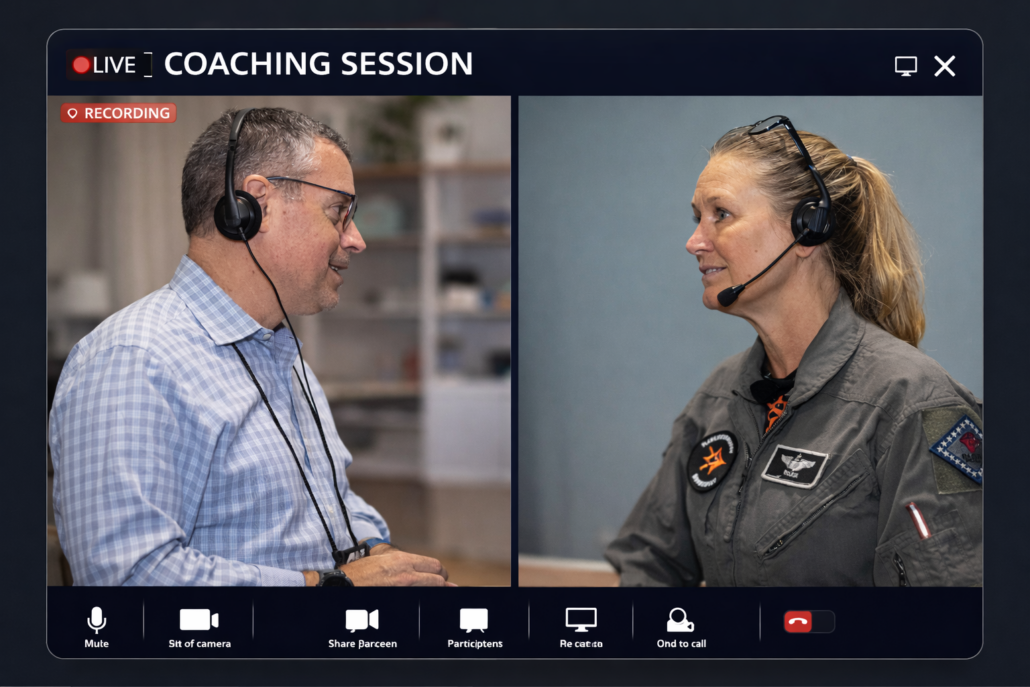
Executive coaching online is a structured, one-on-one leadership development partnership delivered through a virtual platform. It gives leaders direct access to an expert guide and a proven framework to close the gap between their strategy and their team’s execution, without the logistical headaches of travel or rigid scheduling. At its best, it’s not advice. It’s a system.
I’m Christian “Boo” Boucousis, CEO of Afterburner and a former Royal Australian Air Force F/A-18 Hornet fighter pilot. I’ve spent the last two decades applying fighter pilot methodology to business leadership, working with everyone from Fortune 1000 executives to scrappy startup founders. And here’s the thing I’ve learned: the leaders who grow fastest aren’t the ones with the most talent. They’re the ones with the best system for learning. That’s what the right coaching partnership provides.
This post is going to walk you through what executive coaching online actually looks like, how to choose a provider that isn’t just blowing smoke, and how to make sure the investment pays off in ways your CFO can actually measure.
What Is Executive Coaching Online and Why Does It Matter?
At its core, executive coaching online is personalized leadership development delivered through video sessions with a dedicated coach. Think of it as having a seasoned wingman in your corner, someone who helps you sharpen your decision-making, improve team alignment, and turn strategy into action. It’s not therapy. It’s not consulting. It’s a structured partnership designed to make you a more effective leader, session by session, with measurable progress along the way.
Here’s what makes it different from the old model. Traditional executive coaching was reserved for the C-suite, required inconvenient travel, and operated on rigid schedules. Virtual coaching removes those barriers. The Center for Creative Leadership, an organization with more than five decades of research-backed leadership development, has shown that their online coaching delivers participant satisfaction that matches their face-to-face programs. Geography is no longer a filter. The only filter that matters is quality.
And quality, in my experience, comes down to one thing: does the coach have a repeatable framework, or are they just having a nice chat?
At Afterburner, our Flawless Execution Coaching is built on FLEX (FLawless EXecution), the same methodology fighter pilots have used for over sixty years. It runs on a four-phase cycle: Plan, Brief, Execute, Debrief (PBED). It’s not a motivational speech. It’s an operating system. And it works whether we’re in the same room or on opposite sides of the planet.
Why Leadership Development Has Gone Digital
The shift to virtual coaching isn’t just about convenience, though let’s be honest, not having to fly to Atlanta for a two-hour meeting is a relief. The real reason is effectiveness. Modern online coaching platforms allow you to sustain behavior change, track progress with data, and maintain a consistent development rhythm that traditional formats struggle to deliver. Your teams are distributed. Your challenges are complex. Your calendar is packed. A focused 60- to 90-minute virtual session, integrated into your actual workweek, beats a quarterly offsite every time.
The fact is, the best leaders I’ve worked with don’t treat development as an event. They treat it as a daily discipline. Online coaching makes that discipline possible.
What Are the Real Benefits of Executive Coaching Online?
I’ve been coaching leaders for over a decade, and I can tell you the benefits aren’t abstract. They show up in your team’s performance, your decision quality, and (if you’re paying attention) your own stress levels.
It Fits Your Life
Your calendar is already a warzone. The biggest reason leaders skip development is logistics. Online coaching eliminates the friction. You connect with your coach from your office, your home, or (I’ve done this) the back of a rental car between meetings. A focused session replaces what used to be a half-day commitment. That consistency matters. In our world, we say: the debrief that happens every day beats the retreat that happens once a year. The same applies to coaching.
You Get Access to the Best, Not the Nearest
Why limit yourself to coaches in your zip code? With online coaching, you can find the right expert for your specific challenge and industry, someone with a proven approach and a framework that matches your needs. I’ve coached leaders in hospitality, healthcare, logistics, publishing, and defense. In none of those cases did geography determine fit. Expertise did.
It Scales Across Your Organization
For organizations investing in leadership at multiple levels, online coaching is the most efficient way to create a consistent language and a unified approach to execution. You can implement cohesive leadership development programs across departments and geographies without the significant costs of travel and lodging. This isn’t just cost-effective; it’s how you build alignment. When your entire leadership team operates from the same playbook, execution accelerates.
It Creates Accountability You Can Measure
Here’s where most coaching falls down. It feels good in the moment, but nobody tracks whether anything actually changed. Effective online coaching builds in systems to set goals, track progress, and measure impact against real business outcomes. At Afterburner, we tie coaching goals directly to your High-Definition Destination (HDD), a crystal-clear picture of what success looks like, with measurable objectives that your entire team can rally around. If you can’t measure it, you can’t debrief it. And if you can’t debrief it, you can’t improve it.
How to Choose an Online Coaching Provider (Without Getting Burned)
There are a lot of coaches out there. Some are exceptional. Some are people who read a book about leadership and bought a ring light. Here’s how to tell the difference.
Look for Battle-Tested Experience
When you’re looking for a coach, you’re looking for someone who has been in the arena, not just studied it from the stands. Ask about their background. Have they led teams under pressure? Have they worked with companies facing challenges similar to yours? A provider with deep experience in high-stakes environments brings a level of pattern recognition that no certification can replicate. Institutions like the Center for Creative Leadership demonstrate what this looks like at scale: decades of research translated into practical coaching methods.
Demand a Repeatable Framework
This is non-negotiable. Great coaching is not a series of encouraging conversations. It’s built on a clear, repeatable system that gives you and your team a shared language for improving execution. When I evaluate any development program, mine or anyone else’s, I ask one question: does it have a closed-loop process for turning experience into compound growth?
At Afterburner, that process is FLEX. Plan the mission with precision. Brief the team so everyone understands their role and the objective. Execute with discipline. Debrief using ORCA (Objective, Result, Cause, Action) to identify what happened, why it happened, and what to do differently next time. It’s the same system we used flying F/A-18s, and it’s the same system we teach in our coaching programs. The method matters more than the medium.
Make Sure the Technology Disappears
In any virtual engagement, the tech is the bridge between you and your coach. If that bridge is rickety, the whole experience suffers. The platform should be so intuitive that it fades into the background, allowing you to focus on the work. You shouldn’t be troubleshooting audio when you should be pressure-testing your strategy. A good provider has invested in a reliable, seamless tech stack. If they haven’t, that tells you something about their attention to detail.
Insist on Measurable Results
Executive coaching is a significant investment. You deserve to see a return. A reputable provider should be able to show you data, not just testimonials. How do they measure impact? What business outcomes do they tie coaching to? At Afterburner, we connect coaching objectives directly to your HDD and track key performance indicators like productivity, team alignment, and retention. Post-coaching 360-degree reviews show concrete improvements in leadership competencies. If a provider can’t articulate how they measure success, keep looking.
What Does the Online Coaching Process Actually Look Like?
A structured coaching program is more than video calls. It’s a disciplined, repeatable process: Plan, Brief, Execute, Debrief applied to your leadership development. Here’s what to expect.
What Happens in a Session
Each session is a focused, confidential working meeting. It’s your dedicated time to work on your leadership, not just in your business. Your coach helps you dissect your most pressing challenges, identify blind spots, and clarify your next moves. The goal isn’t to feel inspired when you hang up. The goal is to leave with a clear action plan and execute against it before the next session.
In the cockpit, we had a saying: “It’s not what you say; it’s what’s understood.” The same applies here. A great coaching session doesn’t just deliver insight. It ensures you understand exactly what to do with it.
The Assessment and Goal-Setting Process
Effective coaching begins with an honest picture of where you stand. This typically involves an in-depth assessment, which may include 360-degree feedback from your team and peers. It’s not about judgment. It’s about gathering the data you need to build a solid plan.
From there, you and your coach create a development plan with concrete goals tied directly to your business objectives. In FLEX terms, we start with the HDD (High-Definition Destination), a crystal-clear picture of what success looks like. Then we build the mission objectives to get you there. No vagueness. No subjective fluff. Clear, measurable outcomes that your personal growth is directly connected to.
Staying on Track Between Sessions
The real work happens between calls. This is where you apply new frameworks, test different approaches, and gather real-world data. Your coach helps you establish a rhythm: clear action items after each session, key performance indicators to track, and a debrief process to feed learning forward.
This is the compounding effect we talk about at Afterburner. One percent better each day. It doesn’t sound like much. But compounded daily, that’s not 365 percent better. It’s thirty-seven times better. The leaders who build this rhythm don’t just grow during coaching. They keep growing long after it ends. That’s the X-Gap in action: periodically stepping back to ask, is what’s actually happening aligned with what we planned?
Using Coaching to Solve Your Toughest Leadership Challenges
Online executive coaching isn’t self-improvement for its own sake. It’s a tool for solving specific, high-stakes problems.
Close the Execution Gap
Great strategy means nothing without flawless execution. I’ve seen it hundreds of times: a leadership team with a brilliant plan and a team that can’t translate it into daily action. A coach provides the external perspective and the structured process to close that gap.
At Afterburner, this is our bread and butter. We use the X-Gap (Execution Gap) to help leaders identify where reality is diverging from the plan and why. Is it a clarity problem? A communication problem? A capability gap? The X-Gap gives you a disciplined way to find the answer and fix it before small deviations compound into mission failure. One of our manufacturing clients was hitting quarterly revenue targets, but a monthly X-Gap revealed the truth: revenue was up 22 percent, but customer acquisition cost had increased 40 percent, gross margin was down 8 percent, and the sales team was burning out. The cause was a compensation structure that rewarded closed deals, not profitable ones. Without the X-Gap, they would have kept “winning” until the business imploded.
Drive Team Performance
A leader’s growth has a direct ripple effect. When you sharpen your communication, clarify expectations, and learn to empower your people, their engagement follows. I’ve watched this play out with the New York Giants. They were already strong at planning, briefing, and execution. What they were missing was the debrief. Once they adopted ORCA, with players openly owning their mistakes and learning together week by week, they built the alignment and accountability that carried them to a Super Bowl win against the Patriots in 2012.
Your team isn’t that different. The principles are the same. When the leader models honest self-assessment, the team follows.
Lead Through Change Without Losing Your Mind
Change is constant. Whether you’re navigating a merger, rapid growth, or a market disruption, your team looks to you for stability. Online coaching gives you a confidential sounding board and a proven framework to process complexity and lead with clarity. It’s the difference between reacting to every fire and executing a deliberate plan with built-in contingencies, exactly how we plan missions in the fighter pilot world.
Build a High-Performance Culture
Culture isn’t posters on the wall. It’s the shared behaviors and systems that drive results every day. Coaching helps you embed high-performance habits at the leadership level: a consistent framework for planning, briefing, executing, and debriefing that cascades through the organization. This is what we call Flawless Execution, not perfection, but a repeatable cycle of committed action, honest assessment, and continuous improvement.
In our world, we define a Flawless Leader as one who takes their people to destination and grows them along the way. That’s the culture you’re building.
Common Myths About Online Executive Coaching
Let me clear the air on a few things I hear all the time.
“It’s Less Effective Than In-Person”
No, it’s not. Effectiveness isn’t determined by physical proximity. It’s determined by the quality of the coach and the rigor of their framework. A proven, repeatable process for closing execution gaps drives results whether you’re in the same room or on opposite sides of the globe. Some of the most impactful coaching sessions I’ve ever run happened on a screen.
“The Technology Gets in the Way”
It shouldn’t. Today’s platforms are designed to be seamless. If you’re spending more time fighting software than working on your leadership, the provider hasn’t done their job. The tech should be like a good cockpit: everything you need, nothing you don’t, and it fades into the background when you’re in the zone.
“You Can’t Build Real Trust Virtually”
I’ve built some of the strongest professional relationships of my life through video calls. Trust isn’t built on handshakes. It’s built on a shared commitment to growth, honest feedback, and a structured approach that consistently delivers results. A great coach asks the tough questions and gives you the unvarnished truth regardless of the medium.
How to Measure Your Coaching ROI
You invested in coaching. Now prove it was worth it. Here’s how.
360-Degree Feedback
Before coaching begins, gather anonymous feedback from your team, peers, and manager on specific leadership competencies. After a set period, run the review again. You’re looking for measurable shifts in areas like communication, decision-making, and team alignment. This gives you a multi-dimensional view of progress from the people who experience your leadership every day.
Tie Coaching to Business KPIs
This is where coaching moves from “nice to have” to strategic necessity. Link your coaching goals directly to key performance indicators: project completion rates, sales performance, employee turnover, customer satisfaction. When a leader executes more effectively, the numbers show it. At Afterburner, we align every coaching objective to the leader’s HDD and track performance against it. Draw a straight line from development to your bottom line.
Gather Qualitative Feedback
Numbers tell part of the story. Structured conversations with the leader, their team, and the coach fill in the rest. What’s changed in the team dynamic? How has the leader’s approach shifted? These insights are leading indicators of future performance gains and help you understand the full picture of your coaching investment.
Finding the Right Format for You
One-on-One Coaching
The most personalized option. Tailored to your specific challenges, goals, and leadership style. This is where you work through complex issues and receive direct, honest feedback. Afterburner’s Flawless Execution Coaching provides this kind of dedicated partnership: a seasoned expert helping you close your biggest execution gaps using a proven system.
Group and Team Programs
When the goal is team alignment, group coaching builds a shared language and a unified approach to problem-solving. This is powerful for leadership teams executing a new strategy, integrating after a merger, or breaking down silos. It’s also a core focus of our team-building experiences, getting everyone operating from the same FLEX playbook.
Hybrid Models
Some organizations blend virtual sessions with in-person workshops. Regular online coaching maintains momentum, while immersive in-person events kick off strategic initiatives or tackle major challenges. This balance provides accessibility and sustained accountability without sacrificing the energy of working together in the same room.
Understanding the Investment
Viewing coaching as a cost is a mistake. It’s an investment in your organization’s most critical asset: its leaders. A quality program shows up directly in business performance through productivity, retention, and the quality of strategic decisions. A strong coaching partner equips your leaders with a repeatable framework that delivers results long after the engagement ends.
Get the Most Out of Your Coaching
Set Clear Goals from Day One
You wouldn’t start a mission without a clear objective. Before your first session, define what success looks like. Are you trying to improve team alignment? Make faster decisions? Lead more effectively through a transition? A great coach refines these objectives with you, but you should arrive with a clear destination in mind. This strategic clarity ensures every conversation drives toward the outcomes that matter most.
Commit to Action, Not Just Conversation
Insight without action is just overhead. Treat each session as a planning meeting for the weeks ahead. Leave with a clear understanding of the few, high-leverage actions that will create significant change. This commitment to flawless execution is what separates leaders who actually grow from those who just go through the motions.
Keep the Momentum Going
Before each session, review the commitments you made in the last one. What did you accomplish? What got in the way? This continuous loop of action and reflection is the PBED cycle applied to your own development. Plan what you’ll work on. Brief yourself on the objective. Execute. Debrief the results with your coach. That rhythm of continuous improvement builds on itself, and it compounds.
Related Articles
- C-Suite Executive Coaching: Is It Worth the Investment?
- Afterburner | Igniting Business Leader Development
- Our Approach to Flawless Execution
Frequently Asked Questions
Is online coaching really as effective as meeting in person? Yes. The effectiveness of coaching comes down to the coach’s expertise and the strength of their framework, not whether you’re in the same room. A proven, repeatable system for closing execution gaps drives results regardless of the medium. In fact, the virtual format eliminates distractions and travel friction, creating a more focused environment for real work.
How much time does online coaching require? A typical session runs 60 to 90 minutes and fits directly into your workweek. The real commitment is between sessions, applying what you’ve discussed to your actual leadership challenges. The goal isn’t to add more to your plate. It’s to give you tools and a system that makes your current work more effective and more focused.
How do I justify the cost of coaching to my organization? Frame it as an investment in performance, not an expense. Before coaching begins, identify the key performance indicators you want to improve: team productivity, project success rates, employee retention. A structured coaching program tracks progress against those metrics, building a clear business case tied directly to your bottom line.
What’s the difference between a coach and a consultant? A consultant provides answers and delivers solutions. A coach partners with you to develop your own capability. They provide frameworks and accountability so you can find the best answers yourself and build the leadership muscle to solve future challenges without picking up the phone. The goal is to make you better, not to make you dependent.
Can online coaching work for an entire leadership team? Absolutely. Group coaching programs get your whole team aligned with a shared language and a consistent framework for execution. At Afterburner, this is one of the most powerful applications we see: entire leadership teams operating from the same FLEX playbook, debriefing together, and compounding growth as a unit rather than as individuals.