
Why High Pressure Team Simulation Exercises Work
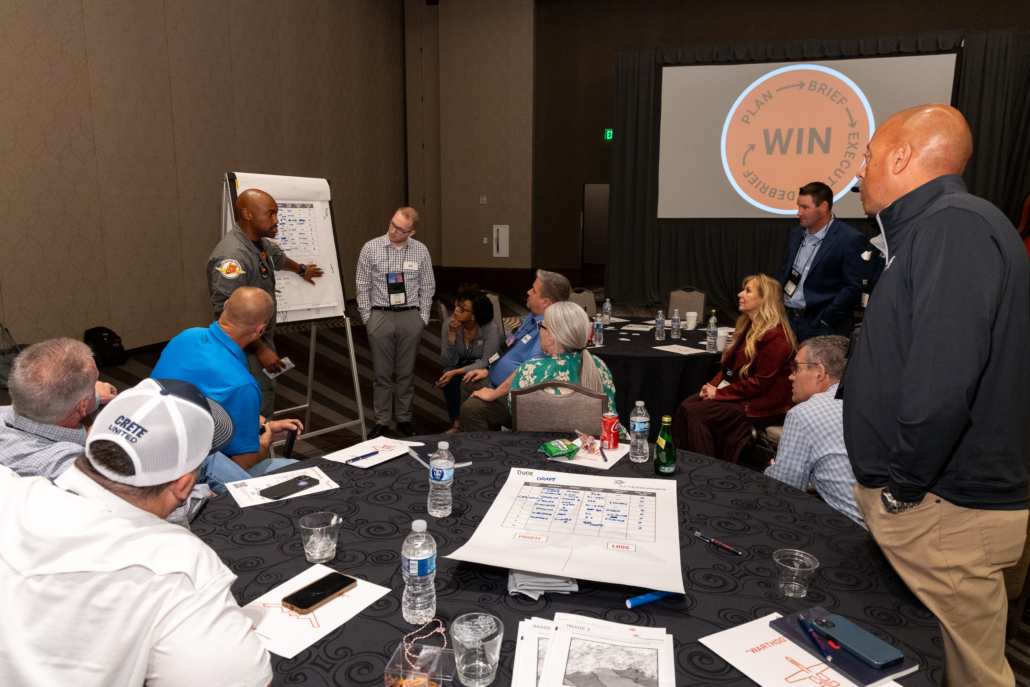
High-Pressure Team Simulation Exercises: How Fighter Pilot Methods Build Teams That Thrive Under Stress
I’ve watched a lot of teams break. Not in dramatic, Hollywood ways. In the quiet, grinding way where people stop communicating, stop trusting each other’s calls, and start running their own private missions inside a shared org chart. Then something goes sideways, a product launch, a market shift, a crisis nobody planned for, and the whole thing comes apart like a bad formation in a thunderstorm.
High-pressure team simulation exercises are controlled, immersive scenarios that replicate the stress and complexity of real business challenges, forcing teams to communicate, decide, and execute under pressure without the real-world consequences. They are one of the most effective ways to expose the execution gaps hiding inside your organization and build the kind of trust that actually holds when things get hard.
Here’s the thing: I didn’t learn this from a management textbook. I learned it sitting on forty thousand pounds of thrust in an F/A-18 Hornet, where the gap between a good decision and a catastrophic one was measured in fractions of a second. I’m Christian “Boo” Boucousis, CEO of Afterburner, former Royal Australian Air Force fighter pilot, and I’ve spent the last twenty years applying the methodology that keeps fighter pilots alive to the teams and organizations that want to perform at that level.
The methodology is called FLEX, which stands for FLawless EXecution. And high-pressure simulation is one of the most powerful ways to install it.
What Is a High-Pressure Team Simulation, and Why Should You Care?
Let me be direct. A high-pressure team simulation is not a trust fall. It’s not an escape room. It’s not your team awkwardly paddling a canoe while someone from HR takes photos.
It’s a practice field for the real world. A controlled environment where your team faces the intensity, ambiguity, and time pressure of a genuine crisis without the actual consequences. The scenario is designed to be realistic enough to trigger real behavior, real communication patterns, and real decision-making under stress. And that’s where the gold is. Because the way your team behaves when the pressure spikes in a simulation is almost exactly how they’ll behave when it spikes for real.
In our world, the fighter pilot world, we don’t send anyone into combat without hundreds of hours of simulated missions first. We build the neural pathways, the communication habits, the decision-making reflexes in a controlled setting, and then we test them under increasing pressure until the response becomes automatic. The cockpit teaches you something most boardrooms never will: you don’t rise to the level of the crisis. You fall to the level of your training.
That principle applies to your team whether you’re launching a product, navigating a restructure, or managing a supply chain disruption. The question is whether you’ve given them the training environment to build those reflexes, or whether you’re hoping they’ll figure it out when the real fire warning lights up.
Why High-Pressure Simulations Build Stronger Teams Than Anything Else You’ve Tried
I get it. You’ve invested in team-building before. You’ve done the offsites. You’ve had the motivational speaker. Maybe you even rented go-karts. And on Monday morning, everyone went back to their silos and did exactly what they did before.
The reason those experiences don’t stick is simple: they don’t connect to the actual work. There’s no pressure that mirrors the pressure your team actually faces. There’s no decision that matters. There’s no consequence for miscommunication. It’s theater, not training.
High-pressure simulations are different because they target the specific mechanisms that drive team performance under stress. Here’s what they actually build:
Decision-Making Under Real Pressure
In the cockpit, when a fire warning light illuminates, the trained response is counterintuitive: sit on your hands. Don’t do anything for ten to fifteen seconds. Think. Is it real? Is it a false alarm? What does the data say? Then act. Not react. Respond.
That gap between stimulus and response is where your training lives. Simulations create the environment to build that gap, to practice making critical calls with incomplete information and a ticking clock. Your team learns to assess, commit, and execute without getting paralyzed by analysis. The quality of your decisions in the moment is determined entirely by the quality of what you built before them.
Communication That Holds Under Stress
Clear communication is the first casualty of pressure. People revert to jargon, assumptions, and the dangerous belief that everyone else knows what they know. In a simulation, that breaks immediately and visibly.
When we work with teams through our immersive team-building experiences, we watch communication patterns in real time. Who talks too much? Who goes silent? Who assumes their message landed without confirming? The simulation surfaces all of it in a way that no survey or personality assessment ever could.
Trust That’s Actually Been Tested
Here’s something I learned the hard way: trust isn’t a feeling. It’s a track record. You trust someone because you’ve seen them perform when it mattered. Google’s Project Aristotle studied over 180 teams and found that psychological safety, the shared belief that the team is safe for interpersonal risk-taking, was the single most important predictor of team effectiveness.
In a fighter squadron, we build that safety through a specific mechanism: the nameless, rankless debrief. Rank insignia come off before you walk in the room. The lead pilot owns their mistakes first, out loud, in front of everyone. When the leader does that, fear of admission drops to zero. The conversation shifts from self-protection to shared learning. The US Navy Blue Angels have debriefed this way after every aerial demonstration for decades: I made a mistake. I fess up. I fix it. I’m happy to be here.
A high-pressure simulation creates the shared experience that makes this kind of trust possible. When your team navigates a complex scenario together, they see each other perform under duress. They learn who steps up, who communicates clearly, who keeps their head. That’s not something you can build over drinks.
Resilience and the Ability to Adapt
The fact is, no plan survives first contact with reality. I’ve been there. Planned for average weather at departure, poor weather over the target, and got something worse than either. The ability to adapt, to shed tasks that aren’t mission-critical and focus on what matters right now, is what separates teams that recover from teams that collapse.
Simulations teach this by design. The scenario shifts. New information arrives. The original plan stops working. Your team has to pivot, and they have to do it together, in real time, with the clock running. That’s how you build the kind of adaptive capacity that turns a team from rigid and fragile into flexible and resilient. It’s a core part of our Flawless Approach to building sustainable performance.
The Scenarios That Matter Most
Not all simulations are created equal. The ones that create lasting change are the ones that mirror the actual pressure your team faces. Here are the categories where I’ve seen the biggest impact:
Crisis Response
A crisis management simulation throws your team into a high-stakes, time-sensitive emergency, a product recall, a data breach, a PR disaster, and forces them to stabilize the situation with incomplete information and competing priorities. This isn’t about testing a plan on paper. It’s about revealing how your team actually behaves when the plan meets reality. In my experience, that gap is always wider than leaders expect.
High-Stakes Execution
Launching a new product? Entering a new market? Executing a major strategic pivot? These are the moments where alignment between functions isn’t just nice to have. It’s the difference between flawless execution and expensive chaos. A simulation lets your team practice the coordination, communication, and decision-making required for these high-stakes plays in a psychologically safe environment where mistakes become learning, not losses.
Cross-Functional Alignment
Silos are the enemy of execution. When your critical project requires tight collaboration between sales, marketing, engineering, and operations, misalignment doesn’t just slow you down. It can be fatal to the mission. A simulation immerses these different teams in a shared, dynamic situation, forcing them to make choices together and experience the consequences in real time. It breaks down the departmental barriers that no amount of Slack channels or cross-functional meetings will fix.
How to Run a Simulation That Actually Changes Behavior
I’ve seen plenty of simulations that were intense, memorable, and completely useless afterward. The experience felt significant, but nothing changed back at the office. Here’s how to avoid that:
Start With Your High-Definition Destination
Before you design the scenario, you need absolute clarity on what you’re trying to achieve. In our FLEX methodology, we call this the HDD, the High-Definition Destination. Not a vague goal like “improve teamwork.” A crystal-clear picture of what success looks like: “Our crisis response team can stabilize a Category 1 incident within 90 minutes with zero escalation failures.”
Without that clarity, you’re running a drill, not building capability. The HDD is what makes the simulation purposeful and the debrief actionable. This focus on mission clarity is the starting point of our Six-Step Mission Planning process, because you can’t hit a target you haven’t clearly identified.
Create Realistic Pressure, Not Artificial Stress
The pressure needs to feel authentic. Your goal is to replicate the specific stressors your team faces: tight deadlines, ambiguous information, shifting priorities, stakeholder pressure. The scenario should mirror the complexity of your actual operating environment closely enough that participants forget, at least for moments, that it’s a simulation.
But here’s a critical distinction: the pressure is controlled. The stakes are about learning, not about careers or quarterly numbers. That’s what makes the simulation psychologically safe, and that safety is what allows people to take the kind of risks that reveal their true capacity.
Ground the Scenario in Your Reality
Generic, off-the-shelf exercises don’t work. The most effective simulations use your company’s language, your industry’s challenges, and your team’s specific execution gaps. Use a recent project failure as inspiration. Build the scenario around an upcoming launch. The more relevant the simulation feels, the more directly the lessons transfer back to daily operations. This is a core principle behind our team-building experiences, relevance is what turns a powerful day into a lasting shift.
Make Psychological Safety Non-Negotiable
This is the foundation everything else rests on. For your team to learn and grow under pressure, they must feel safe enough to fail. That means establishing upfront, before the simulation begins, that mistakes are not just expected, they are the point. The goal is to expose weaknesses in processes and communication, not in people.
In a fighter squadron, we establish this through the nameless, rankless principle. Everyone has an equal voice. The leader goes first in owning mistakes. The governing question is always: It’s not who’s right. It’s what’s right. When you build that culture into the simulation from the start, you create the conditions for the kind of honest, vulnerable collaboration that produces real learning.
The Part Everyone Gets Wrong: The Debrief
Let me tell you what happened with the New York Giants.
In 2011, the Giants were six games into the season with a 4-and-2 record. Coach Tom Coughlin had anything but a mediocre roster. Eli Manning at quarterback, Victor Cruz in his receiver corps, Justin Tuck on defense. They were good at planning. They briefed well. They executed at an elite level. But something was missing.
Their post-game reviews were the same thing they’d been for years. Coaches would call in the players, show the game films, mistakes would be called out, players would grumble, and that was that. There’s a big difference between watching something again, a “re-view,” and a debrief. One is watching, using the passive structures of the brain. The other is learning, unlocking the cognitive structures.
Coach Coughlin had read our book, Flawless Execution, and the section on nameless, rankless debriefs intrigued him. So he called Afterburner. We sent in three of our best trainers and turned their system upside down. We threw out the coaches and gathered the players in the meeting room. We had Eli Manning pick 30 plays and put them on the screen. The rule: if you made a mistake, it was your job to call it out. When a Brandon Jacobs play came on the screen, he immediately said he should have hit that hole harder. A lineman volunteered that he needed to knock the end’s hands down so Eli had a clearer throwing lane. Receivers said they needed to catch more balls and block safeties better.
“It’s not about who’s right,” Coach Coughlin said of the process. “It’s about what’s right.”
Week after week, the communication improved. Players started owning their performance, identifying what they needed to do better, asking for help from teammates. The FLEX debriefs built energy and purpose. The team came together from the inside out. They finished 9-and-7, ranked dead last in rushing offense, and became the first team in NFL history to reach the Super Bowl with a negative point differential. But underneath those numbers was a team that was talking, growing, and improving 1% per day. They won four sudden-death playoffs in a row. And then they won Super Bowl XLVI, defeating a dynasty to do it: Brady, Belichick, and the Patriots.
The FLEX debrief was far from the only reason it happened that year. But the principle it illustrates is universal: the simulation creates the experience, but the debrief is where the learning happens.
ORCA: The Debrief That Changes Everything
In the fighter pilot world, we debrief after every single mission. Not quarterly. Not when the project wraps. After every mission. The framework is called ORCA, which stands for Objective, Result, Cause, Action:
O, Objective: Did we do what we set out to do? Restate the mission objective exactly as defined in the plan. Binary answer: yes or no. Around 83 percent of corporate debriefs stall at this step because the objective was never clear enough.
R, Result: What actually happened? Not the story. The data. Observable outcomes, not opinions.
C, Cause: Why did it happen? Ask “why” until you reach a specific decision or process that caused the gap. Use the root cause matrix: was it an organizational issue, a planning/communication issue, or an execution issue?
A, Action: What will we do differently? One to three actions maximum. Each must be specific, actionable, and owned by a named person. That action feeds directly into the next mission’s plan.
Research in simulation-based education confirms this principle. A peer-reviewed analysis published through the National Library of Medicine describes post-simulation debriefing as one of the most effective components of simulation-based education and the cornerstone of the learning experience. The structured conversation after the event is where participants examine their actions, share their mental models, and convert experience into lasting behavioral change.
Most business “post-mortems,” and the name itself tells you the problem, it’s Latin for “after the end,” are exercises in finger-pointing disguised as learning. ORCA is different because it operates inside a culture of curiosity, not blame. The question is never “who screwed up?” It’s always “what caused the gap between our intention and our reality?”
Close on the High Note
Every debrief ends with what we call the High Note. Acknowledge what was done well. Recognize the effort. Celebrate the learning. End with forward energy. The debrief that ends well is the one people come back to willingly.
One of our clients runs a gold mine. The mine manager has two metrics: production and safety. After adopting ORCA with the High Note closing, his team went from dreading debriefs to requesting them. Why? Because they left energized, not deflated. Production rose. Safety incidents fell. The debrief became the team’s most valuable thirty minutes.
Making the Impact Last Beyond the Event
A simulation without follow-through is just an expensive adrenaline rush. Here’s how you make the lessons stick:
Integrate the Lessons Into Your Daily Rhythm
The debrief produces actions. Those actions need to land somewhere concrete, your next sprint planning session, your weekly leadership meeting, your project kickoff process. If the simulation revealed communication breakdowns, implement a pre-project briefing process modeled on the fighter pilot BRIEF structure. If decision-making was slow, clarify roles and establish a Go/No Go protocol for critical decisions.
The goal is to bridge the gap between the simulation and your operational reality. FLEX, built on the four phases of Plan, Brief, Execute, Debrief (PBED), gives you the repeatable rhythm to do exactly that. Every mission, every project, every week follows the same cycle: plan with precision, brief until everyone understands their role, execute with discipline, and debrief to feed the learning forward.
Build a Culture of Continuous Debriefing
A single simulation highlights areas for improvement. A culture of debriefing compounds that improvement over time. One percent better doesn’t sound like much. But compounded daily, it doesn’t make you 365 percent better by year’s end. It makes you thirty-seven times better. That’s the accelerated learning curve fighter pilots have been running for sixty years.
The debrief isn’t a one-time event bolted onto the back of a simulation. It’s a repeatable rhythm that becomes part of how your team operates. When teams regularly pause to reflect on their performance, honestly, in a psychologically safe space, with ORCA as the framework, they build the kind of continuous improvement engine that separates high-performing organizations from everyone else.
Measure What Matters
You can’t improve what you don’t measure. Before the simulation, identify the metrics you want to influence: project cycle times, error rates, decision speed, communication clarity. After the simulation, track those metrics to see how performance evolves. The data reinforces the new behaviors by showing the team the tangible impact of their efforts. It also gives you the evidence to justify continued investment in this kind of training.
Common Pitfalls, and How to Avoid Them
“My Team Is Already Stressed. Won’t This Make It Worse?”
Fair question. Here’s the critical distinction: the stress your team feels at work is chaotic and comes with real consequences. A simulation provides controlled pressure in a psychologically safe environment. The stakes are about learning, not about quarterly targets or client relationships. The point is to give your team the skills and confidence to handle their real-world pressure more effectively.
Resistance and the Fear of Looking Bad
Nobody wants to fail in front of their colleagues. This is exactly why psychological safety must be established before the simulation begins, not improvised during it. Frame the exercise as a shared learning experience where mistakes are not just expected, they are the most valuable data you’ll collect. When the leader goes first in owning their errors, the fear drops for everyone.
Too Much Pressure, Not Enough Learning
Pressure is a tool, not an end in itself. Too much unmanaged stress and performance collapses. The amygdala hijacks the prefrontal cortex, judgment narrows, and panic sets in. The simulation needs to keep the team in what we call the sweet spot of the Peak Stress Curve: enough pressure to drive energy and clarity, with the trained responses to keep stress from tipping into overwhelm. FLEX is the mechanism that keeps you on that curve.
No Debrief, No Learning
I cannot say this strongly enough: a simulation without a structured debrief is just a stressful event. It’s like flying a combat mission and never analyzing the tape. The experience fades, the habits don’t change, and the next time pressure hits, your team reverts to exactly the same patterns. The debrief, using ORCA, in a nameless/rankless culture, closing on a High Note, is where the simulation’s value is extracted and solidified. Skip it, and you’ve wasted everyone’s time.
Frequently Asked Questions
What is a high-pressure team simulation exercise? A high-pressure team simulation exercise is a controlled, immersive scenario that replicates the stress, ambiguity, and time pressure of real business challenges. It forces teams to communicate, make decisions, and execute under pressure in a psychologically safe environment where mistakes become learning opportunities rather than real-world losses.
How is a high-pressure simulation different from a regular team-building activity? Traditional team-building, escape rooms, trust falls, happy hours, rarely connects to your actual work. A high-pressure simulation mirrors the specific challenges your team faces on the job: the tight deadlines, incomplete information, cross-functional dependencies, and high-stakes decisions. The skills practiced in a simulation transfer directly back to daily operations because they are the same skills your team needs to perform under real pressure.
What makes the debrief so important in a team simulation? The simulation creates the experience, but the debrief is where the learning is extracted and made actionable. Using a structured framework like ORCA (Objective, Result, Cause, Action), teams analyze what happened, identify root causes, and commit to specific improvements. Research published through the National Library of Medicine confirms that post-simulation debriefing is one of the most critical components for translating simulation experiences into lasting performance improvements.
Can high-pressure simulations be customized for our industry? They are most effective when customized. Generic scenarios don’t produce lasting change. The best simulations use your company’s language, reflect your industry’s challenges, and target the specific execution gaps your team needs to close. Whether you’re in healthcare, logistics, tech, or financial services, the scenario should feel like a practice run for the challenges you actually face.
What if our team “fails” the simulation? There is no pass or fail in a simulation. There is only learning. The entire purpose is to uncover weak spots in your processes and communication in a safe-to-fail environment. Mistakes are the most valuable data you’ll collect. It’s far better to identify those gaps during practice than to discover them for the first time when a real crisis hits. As we say in the fighter pilot world: the debrief is where the growth happens, and growth requires honest examination of what went wrong.
Christian “Boo” Boucousis is the CEO of Afterburner, a former Royal Australian Air Force F/A-18 Hornet fighter pilot, and author of The Afterburner Advantage and Flawless Leadership℠. He helps leaders and teams close the gap between strategy and execution using the same methodology that keeps fighter pilots alive at 1,200 miles per hour.