
How to Find a Leadership Development Keynote Speaker
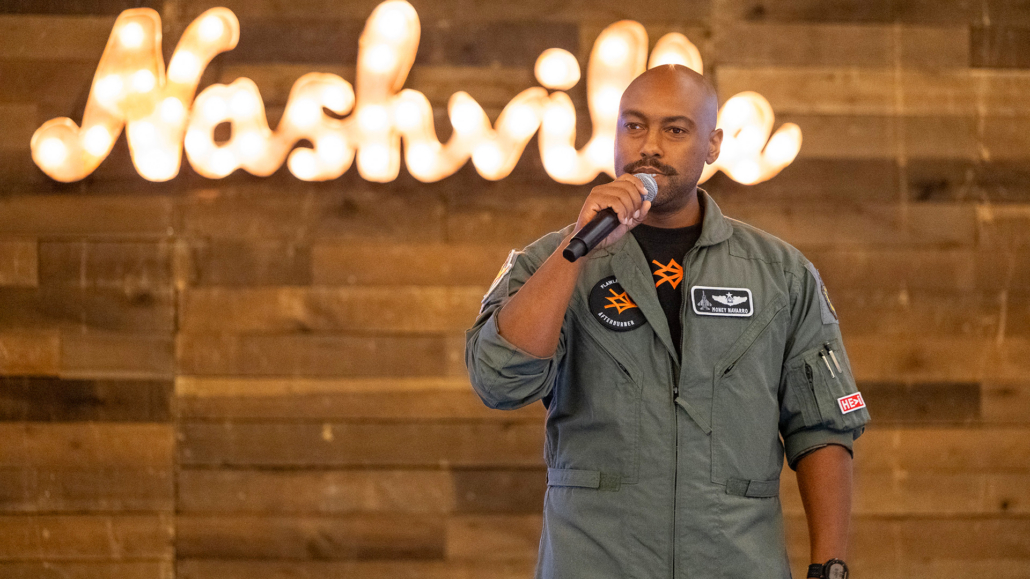
I want to tell you about the day my brain exploded.
It was about ten years ago. I was at a small vineyard in rural Australia, and someone had dragged me along to a leadership seminar put on by a fellow fighter pilot. I arrived loaded with skepticism. A thousand expectant faces in the seats, twenty or so former fighter pilots on the stage, and something clicked. Two completely separate parts of my life, the cockpit and the boardroom, fused into a single idea.
That was my first encounter with Afterburner. Ten years later, I bought the company.
I tell you that story for a reason. That keynote changed the trajectory of my career. Not because it was inspiring, although it was. Because it gave me a practical framework I could use the very next day. It answered a real question I had been wrestling with: how do you take the discipline and execution precision of a fighter pilot community and apply it to a business team?
A leadership development keynote speaker is a strategic partner brought in to equip your team with specific capabilities to perform under pressure and execute your organization’s strategy with greater precision. That is fundamentally different from a motivational speaker, who aims for a temporary emotional lift. A leadership development speaker delivers actionable frameworks, tools your people can use to close the gap between your strategy and your results.
The right speaker provides a shared language and a repeatable system, from the C-suite all the way to the front line. The wrong one wastes a critical opportunity. Here is what to look for, what to avoid, and how to make the investment count.
What Makes the Best Leadership Keynote Speakers Different
The best speakers have lived it. Not studied it. Lived it. They have operated in high-stakes environments where the cost of poor execution was real and immediate. That experience is what makes their message credible, and it is what makes the frameworks they teach actually work under pressure, not just in a conference room.
I’m Christian “Boo” Boucousis, CEO of Afterburner. I’m a former Royal Australian Air Force F/A-18 Hornet pilot. At Afterburner, we have trained over 2.3 million leaders across more than 3,500 organizations, including 94 percent of the Fortune 1000. When I stand on a stage and talk about planning, briefing, executing, and debriefing, I am not reading from a management textbook. I am drawing from the same FLEX, FLawless EXecution, system that fighter pilots have used for over sixty years to keep aircrew alive at 1,200 miles per hour.
Here’s the thing. Credentials matter, but only if they are earned in the field. A great speaker has navigated complex, high-pressure environments where failure had serious consequences. They understand that leadership theory without a practical plan for applying it is useless. Look for someone who can bridge the gap between strategy and action because they have done it themselves. Repeatedly.
How a Great Speaker Sparks Real Change
Real change does not come from a single speech. It starts with a shift in perspective.
Let me tell you what happened with the New York Giants. In 2011, they were six games into the season with a 4-and-2 record. Coach Tom Coughlin had Eli Manning at quarterback, Victor Cruz in the receiver corps, and players like Justin Tuck on defense. They had all the talent. But they were not performing to their potential.
Coughlin read our book and saw something that resonated. He called us in to train his players on the nameless, rankless debrief, the fourth step of our FLEX process. Our approach was different. We threw out the coaches, gathered only the players, and introduced ORCA (Objective, Result, Cause, Action). If you made a mistake, it was your job to call it out. If you did not own up to it, your teammates would.
Brandon Jacobs would see his play come up on the screen and immediately say he should have hit the hole harder. A lineman would call out that he needed to knock down an end’s hands to give Eli a cleaner throwing lane. Receivers said they needed to catch balls and block safeties better. Nobody was being attacked. Everyone was getting better.
The Giants went on to win Super Bowl XLVI against Brady, Belichick, and the Patriots, one of the great dynasties in NFL history. Seventeen other NFL teams hired us within the year.
That is the kind of impact a great leadership keynote can trigger. Not a temporary boost. A new operating system.
Why Bring a Leadership Speaker to Your Next Event
Let me be honest about most corporate keynotes. The standing ovation feels great. Then Monday arrives, the inbox fills up, and the message evaporates. Two weeks later, no one can remember the three key points from the slide deck.
The problem is not the audience. The problem is the content. Most keynotes deliver inspiration without infrastructure. They give people a feeling without giving them a system.
Turn Inspiration into Measurable Action
Inspiration is fine. It does not pay the bills. The real value of a leadership speaker is their ability to translate a powerful message into concrete behaviors that drive business outcomes. The best speakers provide a practical, repeatable framework your team can apply the very next morning.
At Afterburner, our goal is to close the X-Gap, the gap between your strategy and your results, by giving your leaders a clear process. That process is PBED: Plan, Brief, Execute, Debrief. When each phase is executed with discipline, inspiration becomes a systematic practice of continuous improvement, not a fleeting feeling after a good speech. You can see how FLEX drives execution across organizations on our approach page.
Gain Fresh Perspective on Tough Challenges
When you are deep inside the daily operations of a business, it is easy to stop seeing the problems clearly. Your team becomes so accustomed to certain friction points that they stop questioning them.
I have walked into organizations where the same problems had been recurring for years. No one had named them. A twenty-minute conversation in a debrief after the keynote identified the root cause and surfaced a specific action nobody in the building had articulated. That is the value of an outside perspective delivered by someone who has seen the same pattern across hundreds of organizations.
Align Your Teams and Improve Communication
Silos and miscommunication quietly sabotage even the best strategies. One of the most powerful functions of a keynote is creating a single point of alignment for an entire organization. When everyone from the executive team to the front line hears the same message at the same time, it establishes shared language and a common operational framework.
A speaker who introduces clear communication protocols, like the BRIEF mnemonic (Big picture, Restate objectives, Identify threats and resources, Execute, Flexibility) that we use in FLEX, can strip ambiguity from your processes and ensure everyone is working toward the same objective. That unified understanding is the foundation for real cross-functional collaboration. Our Flawless Leadership℠ program builds exactly that kind of alignment.
Create a Lasting Impact on Your Culture
The biggest risk of any event is that the impact evaporates within a week. A keynote should be a launchpad, not a landing strip. The ideas and frameworks introduced by the speaker need to become part of how your organization plans meetings, runs debriefs, and manages performance day to day.
That requires choosing a speaker who offers more than a speech. You need someone who brings a system that can be embedded into your daily operations, a system your leaders will still be using six months later because it actually makes their work easier and their results more consistent.
What Separates a Good Speaker from a Great One
Here is the test I use. A good speaker leaves your team feeling inspired for a day. A great one leaves them equipped with a framework they are still using a year later. The difference is not stage presence. It is substance, relevance, and the ability to translate powerful ideas into practical, repeatable behavior.
Deep Expertise in Both Leadership and Execution
A great speaker has navigated complex, high-pressure environments where the cost of poor execution was real. At Afterburner, every framework we teach has been pressure-tested in environments where failure had consequences that went well beyond a missed quarterly target. That is what makes the FLEX methodology credible. That is what makes it stick.
A Proven Track Record of Tangible Results
The real measure of a speaker’s impact is what happens after they leave. Not just testimonials. Case studies. Measurable outcomes. Organizations that were in a specific situation before the engagement and in a clearly better situation after it. When you evaluate a potential speaker, ask for the evidence. Ask what changed. Ask why.
An Engaging Style That Connects with Your Audience
A brilliant message falls flat if the delivery does not connect. The best speakers are master storytellers. They use real narratives and hard-won personal experience to make complex ideas relatable and memorable. People remember stories long after they have forgotten data points and slide decks. The Fighter Pilot Mindset℠ resonates in a boardroom full of skeptical executives not because it sounds impressive, but because the stories behind it are real, the consequences were genuine, and the frameworks have been proven across thousands of organizations in completely different industries.
Content Tailored to Your Specific Challenges
A generic speech is a wasted opportunity. A great speaker takes the time to understand your goals, your culture, and your most persistent problems before they take the stage. They should function more like a partner than a performer, asking pointed questions about your business situation, your team dynamics, and what you need to achieve. The keynote should feel like it was built for your organization. The best ones are.
How to Choose the Right Leadership Keynote Speaker
Choosing a keynote speaker is a strategic decision. Here is a practical process for getting it right.
Assess Their Expertise and Credentials
Look for authority that is earned, not just claimed. Have they been responsible for executing complex plans with real consequences on the line? Have they led organizations through genuine uncertainty and delivered measurable results?
The best speakers also ask good questions. They should want to understand your goals, your culture, and the specific obstacles your teams face before they agree to take the stage. A speaker who does not ask those questions is going to deliver a canned presentation regardless of what you actually need.
Evaluate Their Style and Audience Fit
Watch full-length videos of their previous talks. Not highlight reels. Pay attention to energy, pacing, and how they handle the room. Consider your team’s culture. A highly analytical audience that is already skeptical of “soft” leadership content needs a speaker who can present a logical, repeatable operational framework. An audience that is burned out and disconnected needs a speaker who can reignite purpose through genuine human storytelling. The right speaker reads the room and adjusts in real time.
Review Testimonials and Past Performance
Go beyond the quotes on the website. Ask for case studies from organizations that faced challenges similar to yours. When you speak to references, ask specific questions: What was the observable impact three months after the keynote? Did teams actually change how they operated? What did the speaker do to customize the content?
Align Their Message with Your Goals
A keynote should never be a standalone event. It must function as a strategic tool designed to advance a specific organizational goal. Before you start your search, define exactly what you want the keynote to achieve. Are you kicking off a major transformation? Aligning teams after a merger? Building a culture of accountability?
Communicate that objective clearly to every potential speaker. The right partner will customize their content around your specific destination, your HDD, your High-Definition Destination, and deliver a message that connects directly to where your organization needs to go.
Common Mistakes to Avoid When Hiring a Speaker
The wrong speaker is not just a wasted afternoon. It is a wasted opportunity to shift something real.
Assuming an expert is automatically a great speaker. Deep expertise and the ability to command a stage are two different skills. You need someone who is both a genuine expert and a master communicator.
Focusing on cost instead of value. What is the cost of not solving your team’s execution problems? A less expensive speaker who delivers a generic, forgettable talk is a sunk cost. A speaker who gives your team a system they use for years is a compounding return.
Accepting a one-size-fits-all message. If the speaker cannot tell you specifically how they will adapt their content for your audience, your culture, and your current challenges, keep looking.
Thinking the impact ends with the applause. A standing ovation is not a business result. The real impact is measured weeks and months later. Are teams still using the frameworks? Are leaders referencing the new vocabulary? Plan for what happens after the speaker leaves the stage.
What Should You Expect to Invest
Hiring a top-tier leadership speaker is an investment, not an event expense.
For a professional leadership development keynote speaker, fees typically range from $10,000 to well over $40,000. That range reflects experience, demand, and depth of content. A speaker at the higher end brings a battle-tested framework honed through real-world application across diverse industries, and the ability to connect that framework directly to your team’s specific situation.
Budget for travel, accommodation, and any technical requirements for the presentation. A professional speaker will be transparent about costs upfront. The best value does not come from finding the cheapest option. It comes from finding the speaker whose message directly addresses your current business challenges and aligns with your event’s strategic goals.
How to Maximize the Speaker’s Impact
A keynote is a catalyst. The real value is unlocked when you treat the presentation as the start of a conversation, not the end of one.
Before the Event: Set Clear Goals
Define what a successful event looks like before you sign a contract. What specific behavior do you want to change? What business challenge are you trying to solve? This is your mission plan. Clear goals let you select the right speaker, brief them effectively, and measure their impact honestly afterward.
During the Event: Create Engagement
The best keynotes are experiences, not monologues. Look for a speaker who engages the audience through interactive exercises, direct challenges, or real-time application of the concepts. When the content is tied to your team’s real problems and the audience is active, the learning goes deeper.
After the Event: Debrief Deliberately
The energy in the room after a great keynote is real. Without deliberate reinforcement, it fades quickly. The first step is a structured team debrief using ORCA (Objective, Result, Cause, Action) to capture key insights and identify specific actions. Then build the speaker’s core frameworks into your regular meetings, planning sessions, and leadership programs.
This is how the keynote becomes a new operating rhythm rather than a one-time event. If you want to see how that sustained reinforcement works at scale, look at our 90-Day Accelerator.
How to Measure the Success of Your Keynote Speaker
The real measure of a keynote is not the standing ovation. It is the observable, measurable change that follows.
Gather Immediate Post-Event Feedback
Go deeper than a simple rating survey. Ask questions that gauge comprehension and intent: “What is the one concept from this talk you will apply this week?” Hosting an immediate team debrief while the content is still fresh is even more powerful. It turns the keynote into an active learning experience.
Track Changes in Behavior and Performance
Before the event, establish clear goals and identify the key performance indicators you expect the speaker’s message to affect. If the talk was about accountability, track project completion rates. If it was about communication, monitor cross-departmental collaboration and decision speed. Draw a direct line from the speaker’s content to your business metrics.
Monitor Long-Term Engagement
Are your leaders using the frameworks in their regular planning sessions? Are teams debriefing after significant missions? Is the vocabulary from the keynote showing up in everyday conversations? These are the signals that the message has moved from the event into the operating system of the organization.
Calculate Your Return on Investment
Quantify the improvements in the KPIs you defined beforehand. What is the financial value of a meaningful improvement in project completion speed, or a reduction in turnover? Compare that gain to the total cost of the speaker. A meta-analysis published in Human Factors by the Group for Organizational Effectiveness reviewed 46 studies and found that properly conducted debriefs improved team and individual performance by 20 to 25 percent on average. When those numbers translate into real financial outcomes, you have not just hired a speaker. You have made a strategic investment in your team’s capability to execute.
When Is the Right Time to Book a Speaker
The most effective keynotes land at critical inflection points, moments when the organization is primed for a new message and ready to act.
Gauge readiness. Before you start looking at speaker bios, take an honest look at your own organization. Is there a recognized need for a shift? Is the team ready to hear a challenge and act on it? The right time to bring in a speaker is when there is an acknowledged gap, in execution, alignment, culture, or capability, and the will to close it.
Plan your timeline. Great speakers book months, sometimes a year or more, in advance. Start your search six to twelve months before your event to ensure you get your first choice and give them enough time to genuinely customize their content.
Consider seasonal availability. The speaking industry peaks in spring and fall, aligned with corporate conferences and sales kick-offs. Plan further ahead during those windows. Booking early gives your speaker the bandwidth to invest real time in understanding your challenges.
Related Articles
- Profit Loss from the Top: How Poor Leadership Impacts the Bottom Line
- Employee Burnout and High Turnover: The Unseen Impact of Poor Leadership Development
- Sabotaging Growth: 7 Ways Weak Leadership Is the Ultimate Business Risk
FAQ
What is the real difference between a motivational speaker and a leadership development keynote speaker?
A motivational speaker aims for a temporary emotional high. Your team feels great for a day and then goes back to exactly what they were doing. A leadership development keynote speaker is a catalyst for lasting behavioral change. They deliver actionable frameworks and a repeatable process your team can use to solve real business problems. Think of it as the difference between a pep rally and a training mission. One provides a short-term lift. The other builds a sustainable capability. The test is simple: is your team still using the frameworks sixty days after the event?
How can a single keynote speech create lasting change in our organization?
The speech itself does not create the change. It sparks it. A great keynote introduces a shared language and a practical framework for execution, like FLEX and the PBED cycle. The lasting change happens when your organization commits to integrating that framework into daily operations through deliberate follow-up, structured debriefs using ORCA, and embedding the concepts into ongoing leadership programs. The keynote is the ignition. Your follow-through is the fuel.
Our leaders are already very experienced. Why do we need an outside speaker?
Even the most experienced leaders benefit from an outside perspective. An external speaker challenges “this is how we’ve always done it” thinking that can stall progress in any organization, regardless of capability. They provide a new, unifying framework that aligns everyone, breaks down silos, and creates a common operational rhythm. Even in the fighter pilot community, we never stopped debriefing. Senior experience does not exempt you from the need for fresh perspective and disciplined self-analysis.
How much should a speaker customize their message for our event?
Significantly. A one-size-fits-all speech is a red flag. A genuine partner will invest real time before the event to understand your organization’s specific goals, culture, and most pressing challenges. They should ask probing questions and tailor their content, stories, and frameworks to be directly relevant to your team. The message should feel like it was built for you.
What is the single most important thing we can do to ensure the keynote has a real impact?
Plan your follow-through before the speaker arrives. The most critical factor is what happens after the applause ends. You need a clear plan to reinforce the message: a structured team debrief using ORCA to capture key insights and identify specific actions, and a deliberate commitment to integrate the core frameworks into your regular meetings, project planning, and leadership development cadence. The keynote is the catalyst. Your commitment to the follow-through is what turns that initial spark into a lasting shift in how your organization operates.
References
[1] Afterburner. (n.d.). Flawless Leadership. https://www.afterburner.com/flawless-leadership/
[2] Afterburner. (n.d.). 90-Day Accelerator. https://www.afterburner.com/accelerator/
[3] Afterburner. (n.d.). Our Approach. https://www.afterburner.com/our-approach/
[4] Tannenbaum, S. I., & Cerasoli, C. P. (2013). Do team and individual debriefs enhance performance? A meta-analysis. Human Factors, 55(1), 231-245. https://pubmed.ncbi.nlm.nih.gov/23516804/
Christian “Boo” Boucousis is a former Royal Australian Air Force F/A-18 Hornet fighter pilot and CEO of Afterburner. He is the author of The Afterburner Advantage and Flawless Leadership℠.