
Top Veteran Leadership Speakers for Your Next Event
Military Leadership Speakers: The Complete Guide to Choosing the Right Expert
Military leadership speakers help organizations improve execution, alignment, and accountability by teaching frameworks forged in high-stakes military environments. The most effective among them don’t simply deliver war stories — they provide structured, repeatable systems that teams can implement immediately to close the gap between strategy and results. Organizations such as Afterburner, led by CEO Christian “Boo” Boucousis, have built entire methodologies around this concept, translating fighter pilot discipline into business operating systems used by over 2.3 million leaders worldwide. [FACT CHECK NEEDED — verify 2.3M figure is current] Whether you are planning a leadership conference, a sales kickoff, or a team-building offsite, this guide covers what to look for in a military leadership speaker, what to expect from the investment, and how to maximize the impact long after the event ends.
Key Takeaways
- Prioritize frameworks over stories. The most effective military leadership speakers deliver a repeatable process — not just motivation. Look for speakers who teach structured systems for planning, execution, and debriefing that your team can apply immediately.
- Define your challenge before you book. Matching a speaker’s core message to your team’s specific execution gap turns a keynote from a morale event into a strategic intervention.
- Plan for impact beyond the stage. The highest-ROI speaker events are designed with pre-event alignment, in-event engagement, and post-event follow-through built into the plan from day one.
What Military Leadership Speakers Actually Bring to Your Event
There is no shortage of motivational speakers on the corporate circuit. What sets military leadership speakers apart is specificity. These are professionals who operated in environments where unclear communication, poor planning, or misaligned teams didn’t just cost revenue — they cost lives.
That background produces a particular kind of presenter: someone who doesn’t trade in vague inspiration but in concrete, pressure-tested operating systems. The best military leadership speakers have translated their combat and training experience into business-applicable frameworks that address the challenges corporate teams face every day — misalignment between strategy and execution, communication silos that erode speed, and a lack of accountability that slowly degrades performance.
This is not about borrowing military jargon for a corporate setting. It is about accessing decades of institutional knowledge about how high-performing teams actually function under pressure, then applying that knowledge to your organization’s specific goals. Companies that have worked with firms like Afterburner report measurable improvements in team alignment, meeting effectiveness, and execution velocity — outcomes that extend well beyond the temporary morale boost of a standard motivational keynote.
The distinction matters for event planners and talent development leaders who are accountable for demonstrating ROI. A military leadership speaker who provides a framework your team still uses six months later delivers a fundamentally different return than one who provides sixty minutes of applause.
The Fighter Pilot Difference: Why Execution Frameworks Matter
Among military leadership speakers, those with fighter pilot backgrounds bring a distinctive advantage. Fighter pilots operate in environments defined by extreme speed, information overload, and zero margin for error — conditions that closely mirror today’s business landscape for leaders managing complex, fast-moving organizations.
What makes their perspective uniquely valuable is not the flying. It is the system they use to perform consistently under those conditions.
The methodology most associated with fighter pilot speakers is Flawless Execution℠, known as FLEX — FLawless EXecution. Engineered from the fighter pilot community and derived from the same operational loop the U.S. Air Force has used for over sixty years, FLEX provides a closed-loop cycle for turning strategy into results and results into learning. The cycle runs on four phases known as Plan-Brief-Execute-Debrief℠ (PBED):
Plan. Define the mission with precision. This begins with setting a High-Definition Destination (HDD) — a measurable, unambiguous picture of what success looks like. Not “grow the business,” but a specific, time-bound outcome the team can verify with a yes-or-no answer. The planning process then works through threats, resources, lessons learned, roles, and contingencies using a structured six-step model.
Brief. Ensure the entire team understands the plan and their specific role in it. In the FLEX methodology, briefings replace meetings. The standard is straightforward: it is not what you say that matters, it is what is understood. A brief that leaves anyone with unanswered questions is a brief that has failed.
Execute. Execute the plan with discipline. In FLEX, execution is not about doing more — it is about doing what matters, maintaining situational awareness, and adapting when reality diverges from the plan. Leaders are trained to stay above the action layer, monitoring progress rather than getting pulled into the weeds.
Debrief. Close the loop using a structured framework called ORCA — Objective, Result, Cause, Action. The debrief is the engine of continuous improvement. Conducted in a nameless, rankless environment, it focuses on one governing principle: it is not who is right, it is what is right. Each debrief produces a single actionable improvement that feeds directly into the next plan, creating a compound growth cycle.
Over 2.3 million leaders have experienced Afterburner’s FLEX programs across industries including healthcare, logistics, hospitality, and financial services. [FACT CHECK NEEDED — verify 2.3M figure is current] The debrief process alone has been credited with transforming teams from reactive problem-solvers into proactive, self-correcting units that compound their performance gains mission after mission.
When evaluating military leadership speakers, the presence of a structured, teachable execution framework like FLEX is one of the clearest indicators that the speaker can deliver lasting organizational value — not just a memorable hour on stage.
What to Look for When Hiring a Military Leadership Speaker
Choosing a military leadership speaker is a strategic decision. The right selection can shift how your entire team operates. The wrong one delivers applause and nothing else. Here is what separates the two.
Real-World Leadership Under Pressure
Look for speakers whose leadership credentials were tested in consequential environments. The most credible military leadership speakers have made high-stakes decisions in real time — in cockpits, in operations centers, in training environments where the gap between a bad call and a bad outcome is measured in seconds, not quarters. That experience gives their message a weight that classroom-trained leadership programs cannot replicate.
A Teachable Framework, Not Just a Compelling Story
A powerful backstory is necessary but insufficient. The best military leadership speakers distill their experience into a repeatable process your team can apply the following Monday morning. When evaluating candidates, ask directly: what will my team do differently after your presentation? If the answer is vague or purely inspirational, keep looking. Speakers who can articulate a clear methodology — such as the Plan-Brief-Execute-Debrief cycle — are the ones who deliver measurable ROI.
Audience Connection and Engagement
Facts alone rarely change behavior. The most effective military leadership speakers combine authentic storytelling with practical application. They do not lecture — they create shared experiences that make concepts like alignment, accountability, and execution feel tangible and urgent. The best keynote presentations feel more like a conversation than a performance and leave the audience equipped with tools they can use the next day.
Cultural Alignment with Your Organization
The speaker’s message should reinforce the leadership culture you are building, not contradict it. Before booking, have a detailed conversation about your organization’s goals, challenges, and the specific behaviors you want to see reinforced or changed. A competent speaker will tailor their message. A great one will embed your language, your objectives, and your context into their framework so the audience walks away feeling like the presentation was built for them.
Speakers Who Turn High-Stakes Experience into Business Results
The market for military leadership speakers includes a range of accomplished professionals — from former fighter pilots and astronauts to special operators and military commanders. What they share in common is direct experience leading in environments where clarity, trust, and execution were non-negotiable.
The Afterburner Team
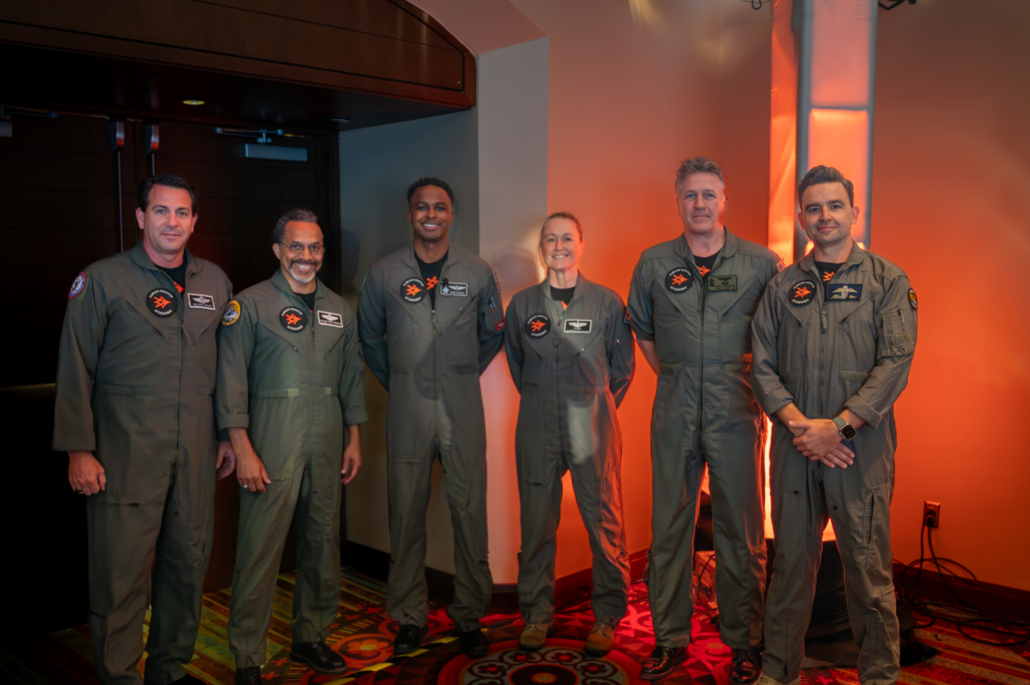
Afterburner occupies a unique position in this space because the organization does not rely on a single speaker. Led by Christian “Boo” Boucousis — a former Royal Australian Air Force F/A-18 Hornet pilot, CEO of Afterburner, and author of The Afterburner Advantage and Flawless Leadership℠ — the Afterburner team fields a roster of former fighter pilots and high-performing professionals who have all lived the principles they teach.
Boucousis brings a distinctive perspective shaped by over twenty years of applying fighter pilot methodology to business leadership across industries including hospitality, publishing, logistics, and healthcare. His approach, grounded in the Fighter Pilot Mindset℠, emphasizes that it is not the flying that creates high performance — it is the disciplined operating rhythm of planning, briefing, executing, and debriefing that any organization can adopt.
Afterburner’s keynote presentations are interactive, high-energy, and anchored in the Flawless Execution℠ methodology. The focus is always practical: how to apply the FLEX cycle to your team’s specific challenges. Their programs extend well beyond keynotes into workshops, team-building experiences, and long-term performance accelerators like the 90-Day Accelerator, making them a strong option for organizations looking for sustained impact rather than a one-time event.
Other Notable Speakers with Military Backgrounds
The broader speaking circuit features many accomplished military and high-stakes leadership speakers who bring diverse specializations and perspectives. Some focus primarily on personal resilience and overcoming adversity. Others specialize in crisis leadership, innovation under duress, or building cohesive organizational culture. When evaluating options, the critical filter is matching the speaker’s core message and methodology to your organization’s specific goals — whether that is improving individual accountability, strengthening cross-functional alignment, or building a sustainable culture of continuous improvement.
Core Lessons Military Leadership Speakers Deliver
Regardless of their specific branch or background, the most effective military leadership speakers return to a consistent set of battle-tested principles that translate directly to business performance.
Building Resilience Through Systematic Learning
Resilience in a business context means more than surviving a difficult quarter. Military leaders develop resilience through rapid iteration — treating every setback as a data point, extracting the lesson, and feeding it forward into the next plan. This approach, formalized through systems like the ORCA debrief, transforms adversity from a morale drain into a growth accelerator. Teams that adopt this mindset do not simply bounce back from failure — they compound their learning over time, getting measurably better with each cycle.
Making Decisions Under Pressure with Clarity
Leaders trained in high-stakes environments are conditioned to act decisively under uncertainty. They assess complex situations quickly, separate signal from noise, and commit to a course of action even with incomplete information. When military leadership speakers share their frameworks for strategic execution, they give your leaders practical tools for making confident decisions without waiting for perfect conditions — a capability that increasingly separates agile organizations from slow-moving competitors.
Forging Accountability at Every Level
In military operations, accountability is structural — it is built into the operating system, not managed through annual performance reviews. Every team member understands their role, owns their actions, and knows that the debrief will surface the truth about what happened and why. When military leadership speakers bring this culture of accountability to corporate teams, the result is a shift from blame-oriented retrospectives to growth-oriented learning loops that drive measurable team performance improvement.
Leading Through Ambiguity and Change
The most valuable military leadership speakers do not just inspire confidence during uncertainty — they provide a system for maintaining clarity when the operating environment shifts. FLEX-trained leaders use the Plan-Brief-Execute-Debrief cycle to continuously adapt while staying aligned on the mission objective. This gives teams a common language and a shared process for navigating change without losing focus, cohesion, or forward momentum.
Which Events Are the Best Fit for Military Leadership Speakers?
Military leadership speakers are versatile presenters, but the highest-impact engagements tend to fall into three categories.
Corporate leadership conferences. For events focused on developing current and emerging leaders, a military leadership keynote provides both the inspiration and the operational framework to anchor the agenda. These speakers connect high-pressure decision-making to everyday leadership challenges in ways that resonate with managers and executives across functions.
Annual kickoffs and all-hands meetings. When the goal is to align an entire organization around a single mission for the year, a speaker who has lived mission-driven execution can set a commanding tone. Framing annual objectives as a mission — with clear roles, defined decision points, and a debrief cadence built into the plan — transforms a standard rally into a structured launch sequence.
Team-building offsites and workshops. This is where military leadership speakers shift from presenting to facilitating. Interactive team-building experiences that apply frameworks like FLEX in real time create deeper engagement and more durable behavioral change than a keynote alone. Organizations seeking sustained improvement should consider pairing a keynote with follow-up workshop sessions that let teams practice the concepts on their own live challenges.
What Does It Cost to Hire a Military Leadership Speaker?
Speaker fees for military leadership experts typically range from $7,500 to over $50,000. [FACT CHECK NEEDED — verify fee range accuracy] The investment reflects the speaker’s depth of real-world experience, the demand for their specific message, and the level of customization involved.
Several factors influence where a specific engagement falls within that range. A standard keynote commands a lower fee than a fully customized workshop or multi-day engagement. The speaker’s career credentials, market demand, and any agency representation play a role. Logistical considerations — travel, event duration, and pre-event consultation — also affect the final investment.
The most productive way to evaluate cost is to focus on return. A speaker who provides a repeatable execution framework your team still uses six months later delivers a fundamentally different ROI than one who provides sixty minutes of inspiration. When building the business case, consider whether the speaker’s offering extends beyond the stage — into workshops, follow-up programming, or long-term consulting — and weight that potential for sustained impact against the upfront fee.
For tailored pricing, contact providers directly. Afterburner’s keynote team offers programs designed to deliver both immediate impact and long-term behavioral change across the full FLEX methodology.
How to Maximize the ROI of Your Military Leadership Speaker Event
A keynote is a catalyst, not a conclusion. The organizations that extract the most value from military leadership speakers are the ones that plan for impact before, during, and after the event.
Before the Event: Align the Message to Your Mission
Get precise about the specific challenge you are solving. Then brief the speaker thoroughly on your business context, team dynamics, and the measurable outcomes you need. The best military leadership speakers — including Afterburner’s team — will customize their presentation around your goals, making the content immediately relevant rather than generically inspirational. The clearer you are about what success looks like, the sharper the speaker’s message will land.
During the Event: Drive Active Engagement
Work with your speaker to identify one to three specific leadership behaviors you want the audience to adopt. Effective military leadership speakers do not just tell stories — they create interactive moments that give teams practice applying the frameworks to their own real-world situations. The goal is to move from passive listening to active ownership of the concepts, so participants leave feeling equipped rather than simply entertained.
After the Event: Embed the Frameworks in Your Operating Rhythm
This is where most organizations leave the biggest gains on the table. The speaker’s frameworks need to be woven into your team’s daily and weekly operating cadence — through follow-up workshops or training sessions that go deeper into the methodology, through regular debriefing sessions using frameworks like ORCA, or through structured planning rhythms that make the PBED cycle a standard part of how your team operates. Without deliberate follow-through, even the most powerful message fades within weeks. With it, a single keynote becomes the foundation of a lasting performance operating system.
Frequently Asked Questions
What is the difference between a military leadership speaker and a standard motivational speaker? The primary difference is the deliverable. Standard motivational speakers aim to inspire, and many accomplish that effectively. Military leadership speakers, particularly those with fighter pilot backgrounds, go further by providing structured execution frameworks — such as the FLEX methodology (Plan, Brief, Execute, Debrief) — that teams can implement immediately. The value is not the emotional uplift alone. It is the repeatable system for planning, executing, and learning that drives sustained performance improvement over time.
How do fighter pilot frameworks like FLEX apply to business challenges? FLEX — FLawless EXecution — is built on the same operational cycle the U.S. Air Force has used for over sixty years. The principles are universal: define a clear, measurable objective; align the team through disciplined briefing; execute with situational awareness; and systematically learn from every outcome through the ORCA debrief process. Organizations across healthcare, logistics, retail, financial services, and professional sports have used these frameworks to improve alignment, accelerate decision-making, and close execution gaps. The methodology works because the underlying challenge — turning strategy into coordinated action under pressure — is identical whether you are in a cockpit or a boardroom.
What should I ask a military leadership speaker before booking them? Three questions matter most. First: what specific framework or process will my team walk away with? Second: how will you customize your message to address our specific challenges and goals? Third: what options do you offer for follow-up engagement to sustain the impact? The quality of the answers will quickly reveal whether you are evaluating a storyteller or a strategic partner who can drive lasting change.
How do I build the business case for investing in a military leadership speaker? Frame the investment as installing a new operating system for your team, not purchasing an event. The ROI comes from the execution framework your team adopts — improved meeting efficiency through structured briefings, faster decision-making through clear planning processes, stronger accountability through regular debriefing, and a culture of continuous improvement that compounds over time. These are measurable organizational outcomes that accumulate long after the speaker has left the stage.
Is a keynote presentation sufficient, or should we plan for additional programming? A keynote is an effective way to introduce new concepts, create shared language, and generate organizational energy. For lasting behavioral change, pairing the keynote with hands-on workshops where teams practice the frameworks on their own real-world challenges delivers significantly deeper results. Organizations that combine a keynote with follow-up team-building or workshop sessions consistently report more durable shifts in how their teams plan, communicate, and execute.