

Why Business Simulation Team Building Is So Effective
Why Business Simulation Team Building Is So Effective
Every fighter pilot spends hundreds of hours in a simulator before they fly a live combat mission. Not because it is a perfect replica of the real thing. It is not. The avionics are simulated. The G-forces are not there. The noise is different.
But the decisions are real. The pressure is real. And the mistakes have consequences you can see and learn from instantly, without anyone getting hurt.
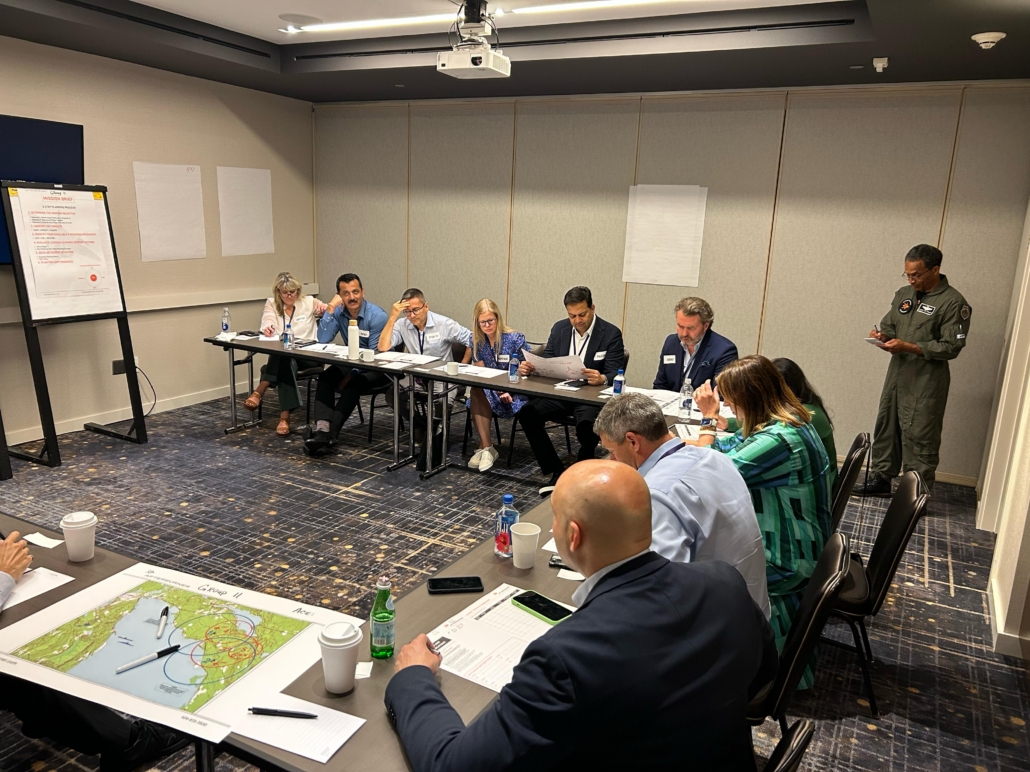
Business simulation team building works on exactly the same principle. It drops your team into a realistic, high-stakes scenario that mirrors the challenges they face every day. Instead of talking about strategy, they execute it. They make decisions, manage resources, communicate under pressure, and adapt when the plan meets reality, all within a compressed timeframe. Then they debrief, extract the lessons, and carry them into Monday morning. It is one of the most effective ways to sharpen decision-making, strengthen collaboration, and build the kind of trust that actually shows up when the pressure is on.
Here’s the thing. I’m Christian “Boo” Boucousis, CEO of Afterburner, and I look at how most organizations develop their teams and think about that simulator a lot. We spend years asking people to make high-stakes decisions in live conditions without ever giving them a practice field. We put leaders into complex, fast-moving environments and then wonder why execution breaks down, communication goes sideways, and the same problems keep showing up mission after mission.
That is exactly the gap a well-designed simulation fills. Done well, it is not a game. It is not a trust fall. It is a structured, high-fidelity environment where your people make real decisions, live with the consequences, and then debrief to extract what they need to do better next time.
That is how fighter pilots learn. It is how winning teams in every high-stakes environment learn. And it works just as well in a boardroom as it does at forty thousand feet.
What Is a Business Simulation?
Think of a business simulation as a hands-on workshop where your team learns by doing. A specific business problem is presented: a market disruption, a product launch, a crisis, a strategic pivot. Participants work in small groups to analyze the situation, develop a plan, and execute it. The simulation responds to their choices in real time, creating immediate consequences they must then manage.
It is one of the most effective ways to practice critical thinking and decision-making in a controlled setting, without the cost of getting it wrong in the real world.
How Do Business Simulations Work?
A well-designed simulation starts with a clear mission briefing. The scenario, the objectives, and the rules of engagement are laid out up front. Teams receive information and resources. As they execute, unexpected challenges arrive and they have to adapt on the fly.
But here is the part most people miss. The simulation itself is not the most important part.
The debrief is.
After the exercise, a facilitator guides the team through a structured review of what happened. What was the objective? What actually happened? What caused the gap between the two? What does the team do differently next time?
That is ORCA: Objective, Result, Cause, Action. It is the same framework fighter pilots have used for decades to turn every mission into a learning event. At Afterburner, we do not just run the simulation and send your team home with a handshake. The ORCA debrief is where the lessons move from the simulation room into the team’s operating system. It is the conversation that matters most.
Why Use Simulations for Team Building?
Simulations work because they create a psychologically safe environment where teams can fail forward. When the stakes are contained, people take risks they would never take in a live situation. They try new approaches. They voice ideas that might get shot down. They give honest feedback without the political freight of a regular performance review.
That freedom builds something most teams never have enough of: trust. Not the kind you talk about in a workshop, but the kind that forms when a team faces a real problem together and figures it out. That shared experience creates a common language and a set of shared standards that carry forward long after the simulation ends.
Why Business Simulations Build Stronger Teams
Most team development programs confuse talking about skills with building them. A simulation removes that gap. Your team is not listening to a presentation about collaboration. They are collaborating, right now, under pressure, with real consequences attached to every decision.
Here is what that actually changes.
Sharpen Decision-Making Under Pressure
In high-stakes environments, the ability to make sound decisions under incomplete information is not optional. It is the whole job. Business simulations act as a flight simulator for your leaders, challenging them with real business problems in a controlled setting. They feel the weight of their choices. They see the immediate outcomes. They learn to filter noise, focus on what matters, and commit to a course of action with confidence.
That is a trainable skill. Simulations train it.
I have seen it firsthand, in the cockpit and in the boardroom. One hour of focused, missionized work with clear objectives and a debrief produces more growth than a full day of reactive busyness. The simulation compresses that cycle. Your team gets reps they would otherwise never get.
Strengthen Cross-Functional Collaboration
Silos are one of the most reliable ways to kill execution. Simulations break them down by design. They force individuals from different departments to unite around a single, shared objective. When marketing, sales, and operations have to work together to complete a mission, they develop a real understanding of each other’s constraints and contributions.
That shared experience builds the connective tissue needed for true cross-functional alignment. Our team building experiences at Afterburner are engineered to create exactly this kind of environment, not a day off from work, but a day that fundamentally changes how the work gets done.
Create a Risk-Free Learning Environment
The most profound learning often comes from failure. In business, the cost of failure can be significant. Simulations provide a space where teams can experiment, take calculated risks, and even get it wrong without jeopardizing real-world outcomes.
This freedom is essential for deep learning. Participants test new strategies, see what works, and absorb valuable lessons from what does not. They also build the resilience to adapt when plans change, which, in my experience, is every single mission.
Accelerate Skill Development
Adults learn best by doing. A business simulation is an active, immersive experience that compresses the learning cycle dramatically compared to passive instruction. Instead of hearing about strategic frameworks, your team applies them in real time. The concepts move from the whiteboard into muscle memory.
That is the core of FLEX, which stands for FLawless EXecution, the methodology we use at Afterburner. FLEX runs on four phases: Plan, Brief, Execute, Debrief (PBED). It is a closed loop, not a checklist. And simulations are the ideal environment for teams to experience that loop at speed, turning concepts into repeatable actions that drive measurable improvements in performance.
Build Trust Through Shared Challenges
Trust is not built in a classroom. It is forged in shared difficulty. Business simulations provide a challenge that requires team members to rely on one another, communicate with clarity, and hold each other accountable to the mission.
As they work through the scenario together, they build the mutual respect and psychological safety that are the foundation of any high-performing team. That shared reference point extends long after the simulation ends. It becomes part of how the team talks about problems, makes decisions, and holds each other to account.
In my fighter pilot world, we called this the “crew room” effect, the trust that builds when you have faced something hard together and come out the other side. A simulation creates that same dynamic for your team.
What Types of Business Simulations Are There?
Business simulations are not one-size-fits-all. They are versatile tools that can be designed to address specific organizational challenges, from high-level strategy to frontline leadership. The key is matching the type of simulation to the specific skills you need to build.
Strategic Planning Simulations
Strategic planning simulations move your company’s vision from a slide deck into a dynamic, interactive challenge. Your team has to make high-stakes decisions and see the immediate consequences, rather than debating options in the abstract.
These simulations test and refine the ability to think long-term, align on a shared mission, and adapt the plan when conditions change. At Afterburner, our strategic planning workshops are built on the Six-Step Mission Planning process fighter pilots use in combat, the same process that helps teams bridge the gap between a great idea and flawless execution.
Crisis Management Scenarios
How does your team perform when the pressure is on and the information is incomplete? Crisis management scenarios answer that question in a controlled setting. They drop teams into intense, unexpected situations and force them to communicate clearly, solve problems creatively, and make decisions without the luxury of certainty.
Let me tell you what I have learned about crisis response after a career in fast jets: the teams that perform under pressure are not the ones with the most talent. They are the ones who practiced under pressure. They built the muscle memory to remain calm and focused when a real crisis arrived, rather than improvising under fire for the first time.
Leadership Development Simulations
Great leaders are not born. They are built through deliberate experience in high-stakes conditions. Leadership development simulations accelerate that process. They put emerging and established leaders in charge of a team or project and task them with achieving a specific goal.
Along the way, they practice delegation, feedback, motivation, and conflict resolution in a setting where the lessons are immediate and clear. It is one of the most effective ways to build the next generation of leaders through targeted, practical experience.
McKinsey research found that high performers in complex leadership roles deliver 800 percent more impact than average performers. Each exceptional leader’s output equates to roughly twelve employees. That is a staggering multiplier, and it means accelerating leadership development is not a nice-to-have. It is the single biggest lever in your organization.
Cross-Functional Team Challenges
In many organizations, the biggest barriers to execution are the invisible walls between departments. Cross-functional team challenges are designed to tear those down. They bring people together from different parts of the business and give them a mission they can only accomplish by collaborating.
These experiences build empathy, improve communication, and create the trust that real collaboration requires. An immersive team building experience like The Top Gun Experience can align disparate groups around a single, shared objective in a way that months of meetings rarely achieve.
How to Choose a Business Simulation Provider
Not all simulations are created equal. The experience can range from a digital game to a fully immersive, facilitated event. The right provider is the difference between a fun afternoon and a fundamental shift in how your team operates.
Here is what to look for.
A Proven, Practical Framework
The most effective simulations are built on a foundation your team can actually use back on the job. The simulation should not be an isolated event. It should be a hands-on demonstration of a new way of working, a repeatable operating system that helps teams cut through complexity and execute with precision.
When you walk out of a simulation, you should be holding a framework you can run on Monday morning, not just a good memory from Thursday. At Afterburner, that framework is FLEX. Plan it. Brief it. Execute it. Debrief it. Every simulation we run is built on that cycle.
Realistic Scenarios and Psychological Safety
For learning to stick, the scenario has to feel real. The challenges should reflect the actual pressures your team faces. But just as important is the culture of the room. The simulation needs to be a blame-free environment where people feel safe taking risks and making mistakes.
That combination of realism and safety is what allows for deep behavioral change. Without psychological safety, your people will protect themselves rather than learn. The ORCA debrief only works when people can name the root cause honestly, including when the root cause is themselves.
In the fighter pilot debrief room, we had a phrase for this: nameless and rankless. Rank insignia went into a tray by the door. Inside that room, everyone had an equal obligation to the truth. The governing principle was simple: it is not who is right. It is what is right.
Customization and Flexibility
Your organization has specific goals. A generic simulation is not going to address them with precision. A great provider will tailor the experience to fit your strategic objectives, your industry’s pressures, and your team’s current dynamics.
Whether you are integrating a new team, preparing leaders for growth, or navigating a major strategic shift, the program should be built around your real-world situation, not a template.
Expert Facilitation
The facilitator is as important as the program itself. An expert facilitator does more than explain the rules. They guide the team, ask the questions that surface the real insight, and connect the lessons from the simulation directly to your business priorities.
The best facilitators have deep real-world experience in high-stakes environments. They can command a room of senior leaders, create an environment of focus and accountability, and turn an engaging activity into a genuine shift in how the team operates.
Clear Metrics and Actionable Feedback
How do you know if the simulation worked? The best providers build clear metrics and feedback loops directly into the experience. Your team should see the immediate impact of their decisions. And the structured debrief at the end is non-negotiable.
That is where ORCA turns outcomes into insights and insights into new behavior. The goal is to leave with a clear answer to one question: what do we do differently on the next mission?
How the Debrief Changed Everything: A Quick History
Let me give you some context on why I am so obsessive about the debrief.
Prior to the founding of Top Gun in 1969, US Navy fighter pilots were winning at a 2.5-to-1 ratio in head-to-head air combat. After Top Gun institutionalized the structured debrief, that ratio increased to 12.5:1. Same pilots. Same aircraft. A better learning system.
During Operation Rolling Thunder between 1965 and 1968, US forces lost roughly 900 aircraft. Lessons were not being captured, shared, or translated into tactics at scale. In response, the military institutionalized a disciplined learning loop: formalized tactics development, rigorous training, and objective brief-and-debrief practices. When the US returned to large-scale air operations during Operation Linebacker in 1972, total aircraft losses dropped to approximately 134, despite facing a denser and more lethal air defense environment.
A 400 percent improvement in kill ratio. A 650 percent reduction in losses in a tougher environment. All from a better learning process.
When is the last time a conversation in your organization delivered that kind of impact?
That same debrief discipline is what sits at the heart of every business simulation we run at Afterburner. The simulation is the practice field. The debrief is where your team gets better.
In-Person vs. Virtual: Choosing the Right Format
Deciding between an in-person or virtual simulation is a strategic choice, not just a logistical one. Both formats can be highly effective. The quality of the framework and the facilitator matters far more than the location.
Immersive In-Person Experiences
There is a unique power in bringing your team together physically. Immersive, in-person team building removes distractions and creates a focused environment for deep learning. Working shoulder-to-shoulder through realistic business scenarios builds a level of trust that is hard to replicate through a screen.
For teams looking to make a significant cultural shift or reset their operating rhythm, an in-person event like The Top Gun Experience provides the catalyst. The shared experience becomes a reference point the team carries forward.
Flexible Virtual and Hybrid Options
For distributed teams, virtual simulations remove the barriers of travel cost and scheduling complexity, making powerful team development accessible to everyone. Modern virtual simulations are designed for genuine engagement, allowing participants to connect from any device and collaborate in real time.
This format works well for reinforcing key concepts, connecting cross-functional teams across geographies, or maintaining the learning rhythm between larger in-person events. The framework does not change because the room is virtual. FLEX (Plan, Brief, Execute, Debrief) works just as well on a screen as it does in a conference room.
Common Myths About Business Simulations
A few misconceptions tend to slow leaders down when they are considering simulations. Let me address the ones I hear most often.
Myth: They Are Just a Fad
Simulations are not a trend. They are a proven method for building critical skills through hands-on application. The underlying principle, that people learn faster by doing than by listening, and learn faster still when they debrief immediately after, is the same principle that has been driving accelerated development in the fighter pilot community for over sixty years.
The Top Gun data I shared earlier tells the story. The structured debrief did not add new technology. It added a better learning system. That is not a fad. That is a fundamental truth about how humans improve.
Myth: They Are Too Complex and Expensive
Some simulations can be complex. The best ones are not. They are built for clarity and practical application. And when you consider the cost of poor execution, misaligned strategies, and a team that keeps making the same mistakes, the investment in a targeted simulation looks very different.
The ROI is not about the simulation itself. It is about the behavioral change that follows.
Myth: One Size Fits All
The most impactful simulations are tailored to your organization’s specific challenges. A simulation designed for a healthcare team looks very different from one built for a technology company or a financial services firm.
The core methodology is the same: Plan, Brief, Execute, Debrief. But the scenarios, the language, and the objectives should reflect your world, not a generic template.
What Results Can You Expect?
Business simulations are designed to produce measurable improvements in how your team operates. Here is what I have seen change across the thousands of leaders we have trained at Afterburner.
Clearer Communication and Strategic Alignment
Simulations force teams to communicate with clarity and purpose under pressure. Participants see exactly how their decisions impact the larger mission in real time. That creates a shared understanding of the strategy and each person’s role in executing it.
When everyone understands the HDD (High-Definition Destination) and their individual contribution to reaching it, you get the kind of alignment that turns plans into results.
Stronger Collaboration and Problem-Solving
Effective teamwork is not about getting along. It is about solving hard problems together when the clock is running and the information is incomplete. Simulations create the psychological safety for teams to experiment with new approaches and fail without real-world consequences.
By tackling complex challenges in a contained setting, team members learn to rely on each other’s strengths, build trust, and develop a shared process for working through obstacles.
Tighter Goal Alignment and Adaptability
Adaptability is a survival skill. Simulations help teams practice making high-stakes decisions with imperfect information, and they practice pivoting when the original plan stops working.
By doing this in a controlled environment, your team builds the muscle memory to stay aligned and agile in real conditions. That is the heart of the Fighter Pilot Mindset℠: not having all the answers, but having a system that keeps the team moving effectively when the answers are not yet clear.
Lasting Changes in Behavior and Performance
The most significant outcome of a well-designed simulation is an observable shift in how your team performs after it ends. Participants do not just hear about better leadership. They practice it.
The skills and habits formed under simulated pressure carry forward. The result is a team equipped with a repeatable framework for planning, executing, and debriefing, a framework that drives lasting performance improvement, not just a good day out of the office.
How Much Do Business Simulation Programs Cost?
The investment in a business simulation varies based on a few key factors. It helps to think of it less as a cost and more as an investment in your team’s ability to execute your strategy with precision.
What Influences the Cost?
The main variables are the level of customization, the number of participants, the depth of facilitation, and the format and duration of the program. A tailored, multi-day, in-person experience with expert facilitators will require a larger investment than a standard virtual session.
But the customized, facilitated experience is also where the deepest behavioral change happens. The debrief quality alone, guided by a facilitator who understands your business and can draw the precise connections between the simulation and your real-world challenges, is what separates a memorable event from a transformational one.
Understanding Pricing Models
Most providers use one of two models: a per-participant fee or a flat project-based rate that covers consultation, scenario design, materials, and facilitation. For comprehensive workshops, the project-based model is more common and more transparent.
When you are evaluating options, get a clear breakdown of what is included: pre-event planning, materials, facilitator preparation, and any post-event follow-up. A provider who is straightforward about costs is a provider who is confident in what they deliver.
How to Measure the ROI
Define your goals before the simulation starts. Are you trying to accelerate decision-making? Break down cross-functional barriers? Improve strategic alignment?
Measure your baseline before the event, then track tangible evidence of change afterward. Are teams using the PBED planning and debrief frameworks in their regular operations? Are project cycle times improving? Are the same execution failures repeating, or have they been addressed?
The true ROI shows up when your team consistently executes with greater speed, alignment, and precision, and when they can tell you exactly why they are performing differently.
Is a Business Simulation Right for Your Team?
Business simulations are not industry-specific. They are powerful tools for any team that needs to sharpen how it plans, communicates, and executes under pressure.
Teams in High-Stakes Environments
Finance, technology, healthcare, logistics: if your team operates where every decision has significant consequences, a simulation provides the practice field your people need. They build the muscle memory to act decisively and stay aligned when it matters most.
Complex or Matrixed Organizations
In large or matrixed organizations, silos and miscommunication can derail the best strategies. Simulations break those barriers by placing individuals from different departments into a single, mission-focused scenario. They see in real time how their individual actions affect the larger group. That experience builds the cross-functional trust and alignment that is essential for executing at scale.
Teams Undergoing Transformation or Growth
For teams navigating a merger, rapid scaling, or a major strategic pivot, uncertainty can create misalignment fast. Simulations give leaders and their teams a place to practice adapting to new situations and developing new plans in real time. A well-designed strategic planning workshop within a simulation can completely change how an organization prepares for what comes next.
Distributed and Cross-Functional Teams
Remote and hybrid work make cohesive team culture harder to build and easier to erode. Business simulations provide a dynamic, psychologically safe environment to unite distributed teams around a shared mission. The experience creates genuine connections and a common language for problem-solving that transcends geography and function.
How to Choose and Implement Your Program
Choosing a simulation is a strategic investment, not an activity selection. The most successful programs are thoughtfully chosen and deliberately implemented. Here is how to approach it.
Start by Assessing Your Team’s Needs
Effective team development always starts with an honest assessment of where you are today. What are the friction points in how your team plans and executes? Where does communication break down? What specific capabilities, whether strategic thinking, crisis response, or cross-functional alignment, does your team need to strengthen?
A clear diagnosis is the only honest starting point for a program that will actually move the needle.
Select the Right Program and Features
Once you know what you need, look for a program built on a practical, proven framework. The simulation should challenge your team with realistic problems in a contained environment, create genuine psychological safety for experimentation, and be led by facilitators who can connect the experience directly to your business priorities.
The goal is not to win the simulation. The goal is to walk away with a repeatable process your team can apply on the next real mission.
Implement for Maximum Impact
The simulation is one part of a complete learning journey. True impact comes from a thorough introduction, a well-designed simulation activity, and a structured debrief.
That debrief, running ORCA on what happened, is where the “aha” moments occur and where lessons become action plans. A well-designed implementation connects the simulation experience directly to your team’s work, so participants leave with a clear picture of how to apply what they learned.
That connection is what turns a single event into a sustained shift in how the team performs. You can see what that looks like in our Flawless Leadership℠ program.
Related Articles
- Are You Stuck in the ‘Do Loop’? A Super Bowl Leadership Case Study
- The Complete Guide to Experiential Team Building
- Unleash the Leader Within: The Top Gun Experience for Trust Building
FAQ
How is a business simulation different from a typical team-building day?
Think of it as a practice field rather than a picnic. Most team-building activities focus on socializing. A business simulation is a hands-on workshop designed to improve the specific skills your team uses every day: communication, decision-making, strategic execution, practiced in a realistic scenario under real pressure. The experience ends with a structured ORCA debrief that connects the lessons directly to your business goals. You leave with new habits, not just a good story.
Will the simulation be relevant to our industry and our specific challenges?
A quality simulation is never a generic product. The most effective programs are tailored to reflect the real-world pressures and strategic objectives your team is actually facing. A great provider will work with you to understand your market, your internal dynamics, and your goals, so the scenario generates insights that are immediately applicable, not abstract lessons you have to translate on your own.
Is this only for executive teams, or can people at all levels benefit?
The core principles, clear communication, disciplined planning, nameless and rankless accountability, are valuable at every level of an organization. The programs can be adapted for emerging leaders through to the C-suite. The real benefit is creating a shared language and a consistent framework for execution that everyone in the company can use. When the same operating system runs from the front line to the boardroom, alignment stops being a goal and starts being a reality.
My team is distributed globally. Can we still do this effectively?
Yes. The best providers offer virtual and hybrid formats designed specifically for distributed teams. A well-facilitated virtual simulation creates the same focused, psychologically safe environment as an in-person event. The key is the quality of the framework and the facilitator, not the physical location. FLEX (Plan, Brief, Execute, Debrief) works on a screen just as well as it does in a conference room.
How do you ensure the learning actually transfers back to real work?
This is the most important question. The simulation is the practice. The structured debrief is where the learning is locked in. Using ORCA (Objective, Result, Cause, Action), a skilled facilitator guides your team to analyze their performance, find the root cause of every gap, and create specific action plans. The goal is not just an engaging experience. The goal is a team that leaves with a repeatable process they can run on their next real mission, the next morning.
References
[1] Afterburner. Team Building Experiences. https://www.afterburner.com/team-building/
[2] Afterburner. Strategic Planning Workshops. https://www.afterburner.com/workshops/strategic-planning/
[3] Afterburner. Flawless Leadership℠ Program. https://www.afterburner.com/flawless-leadership/
[4] Afterburner. The Top Gun Experience. https://www.afterburner.com/team-building/top-gun-experience/
[5] Keller, S. & Meaney, M. “Attracting and retaining the right talent.” McKinsey & Company, November 2017. https://www.mckinsey.com/capabilities/people-and-organizational-performance/our-insights/attracting-and-retaining-the-right-talent
[6] Boucousis, C. The Afterburner Advantage. Afterburner, Inc.
[7] Boucousis, C. Flawless Leadership℠. Afterburner, Inc.

